
Trackers, Bugs, Cameras: What Radio Listening Reveals
· 6 min read · Updated
Lire en français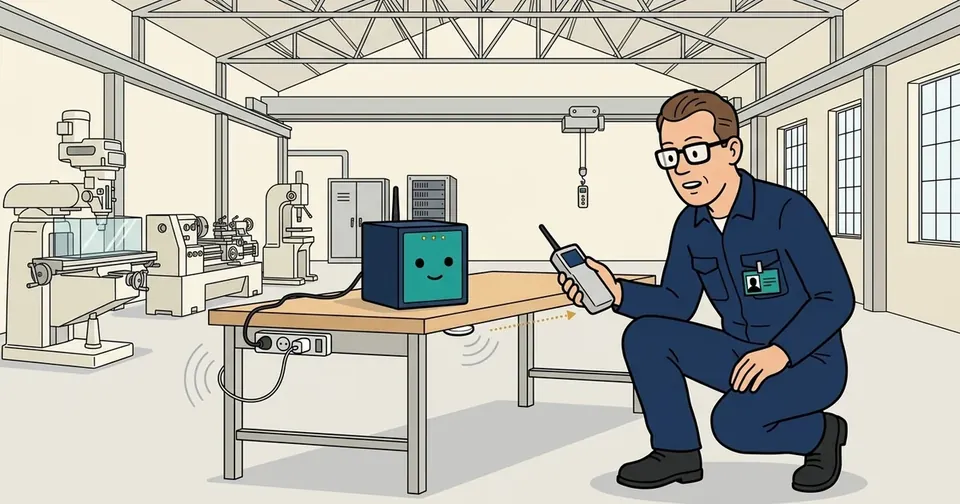
Twenty years ago, planting a bug in a meeting room required specialised equipment and some know-how, while today a Bluetooth tracker is sold in supermarkets, a bug that calls back a number as soon as it hears a voice sells online for the price of a meal, and a Wi-Fi camera fits inside a phone charger. Most of these objects were designed for perfectly legitimate uses, finding one's keys or watching one's home, which is precisely what makes them so easy to misuse, but nearly all of them betray themselves through their emissions, and that is what permanent radio listening can pick up.
This article is for managers of sensitive sites, meeting rooms and technical rooms wondering what radio monitoring can do against such objects.
Three families of objects, three signatures, from the Bluetooth tracker to the Wi-Fi camera
All these objects share a feature that is also their weakness, because to be useful to whoever planted them they must transmit what they capture, and any wireless transmission leaves a trace in the radio spectrum, that is in the whole range of frequencies on which one can transmit, provided one knows where to look.
Location trackers. Consumer Bluetooth trackers, such as Apple's AirTag, have no connection of their own, because they emit a short Bluetooth Low Energy, or BLE, advertisement which passers-by's phones relay to the manufacturer's network, so they are both discreet and talkative, since they announce their presence at short and regular intervals. Trackers with their own cellular modem, more expensive, transmit far less often, in brief bursts on mobile bands.
Bugs. The most common use a SIM card and the mobile network, so they stay silent and then call or transmit as soon as a sound is detected, while others transmit continuously on free radio frequencies, like a small FM transmitter, and some record to a memory card to transmit only later, or never.
Cameras. Most now use Wi-Fi, either joining an existing network or creating their own, and analogue models, still common in cheap equipment and in the drone world, transmit a picture continuously on frequencies such as 1.2 or 5.8 GHz.
What permanent radio listening can do
Radio listening installed permanently, like that of the Cube, our on-site decision unit (overview), has over a one-off sweep, that is a search done once with a portable receiver, an advantage we consider decisive, because it knows the usual landscape of the place, it knows which devices are present every day, at what times and at what signal strength, and it is the deviation from this baseline that interests it. It receives and does nothing but receive, since it never tries to connect to what it hears nor to disturb it.
Spotting a new Bluetooth transmitter that stays. A tracker forgotten in a bag crosses the building with its owner, while a tracker placed under a desk or attached to a company vehicle stays there, day after day, and the persistence of an unknown transmitter, matching no enrolled token, is a more reliable signal than its mere appearance. Apple and Google have also submitted to the IETF a joint text for detecting unwanted trackers, which makes some of these objects easier to recognise. That initial text has expired. The work continues in the DULT working group, whose accessory protocol reached its second version on 27 October 2026 without yet being published as an RFC.
Spotting a Wi-Fi network or device that has no business there. An access point appearing in a meeting room, or a device continuously sending a lot of data from a fixed spot, deserves a check, and we described in A Wi-Fi Honeypot That Grants Nothing what the Cube does with a probe or a fake network aimed directly at it.
Spotting an emission where there should be none. On other bands, wider listening, entrusted to a software-defined radio, or SDR, can establish that an emission appears at an unusual frequency and time, even without being able to tell what it carries, and without trying to find out.
We went further into how the Cube listens to these bands, and how it detects attempts to blind or deceive it, in Who Is in the Room?, What an SDR Finds and Jamming, Relays and the Flipper Zero.
What escapes it
We think it essential to be as precise about limits as about capabilities, because a false sense of security seems to us worse than no protection.
- An object that does not transmit cannot be seen. A bug recording to a memory card, a switched-off device or a tracker in deep sleep leave no radio trace, and finding them requires other techniques, such as non-linear junction detection or physical inspection, which are the trade of countermeasure specialists, or TSCM for technical surveillance countermeasures, whose job is precisely to look for these objects on site.
- A very short burst can slip between two measurements. A cellular bug transmitting for only a few seconds, while the listener looks elsewhere, can escape a sweep, and permanent listening reduces this risk without removing it.
- An emission is not a confession. A building's spectrum is saturated with legitimate emissions, and only persistence, location and context distinguish a suspicious object from a visitor's phone.
- Locating requires legwork. A fixed listener says something is happening within its perimeter, but finding the object then means moving around with a portable receiver and a directional antenna.
What the law allows, and what it forbids
Detecting transmitters in one's own premises does not seem to us to raise any particular legal difficulty, and it is even a precaution that the protection of sensitive information justifies, but two limits must be respected, and we give the French references here, since similar rules exist in other European countries.
First, detecting is not listening, because capturing, recording or transmitting words spoken in private without their author's consent is an offence (Article 226-1 of the French Criminal Code), as is intercepting correspondence (Article 226-15), so legitimate radio monitoring is interested in the existence of emissions, their frequency and strength, never in their content.
Second, the manufacture, import, possession and sale of devices designed to carry out such interceptions are regulated and subject to authorisation (Article 226-3 of the French Criminal Code), and the receivers we use are general-purpose radio equipment, which measure and do not demodulate third parties' communications, and we intend to keep it that way.
Finally, like any device installed in premises where employees work, permanent radio listening must be presented to the works council and brought to people's attention, even if it does not target their activity, and we discussed this in Detecting Presence Without Monitoring Employees.
Where to start
If the question arises for your site, we would suggest starting by defining the places that really matter, a boardroom, a laboratory or a technical room, installing radio listening there for a few weeks in plain observation to establish the baseline, and only then deciding which alerts to arm. For an in-depth search, notably before a sensitive meeting, calling on a countermeasure specialist remains the right answer, and permanent listening will be valuable to them, since it will tell them what has changed since their last visit.
Sources
- IETF, Detecting Unwanted Location Trackers, initial draft submitted by Apple and Google (draft-detecting-unwanted-location-trackers, last version 20 December 2023, expired). datatracker.ietf.org
- IETF, DULT working group, Detecting Unwanted Location Trackers. datatracker.ietf.org
- French Criminal Code, Articles 226-1, 226-3 and 226-15, and Articles R226-1 et seq. (list and authorisation of devices).