
A Wi-Fi Honeypot That Grants Nothing
· 6 min read · Updated
Lire en français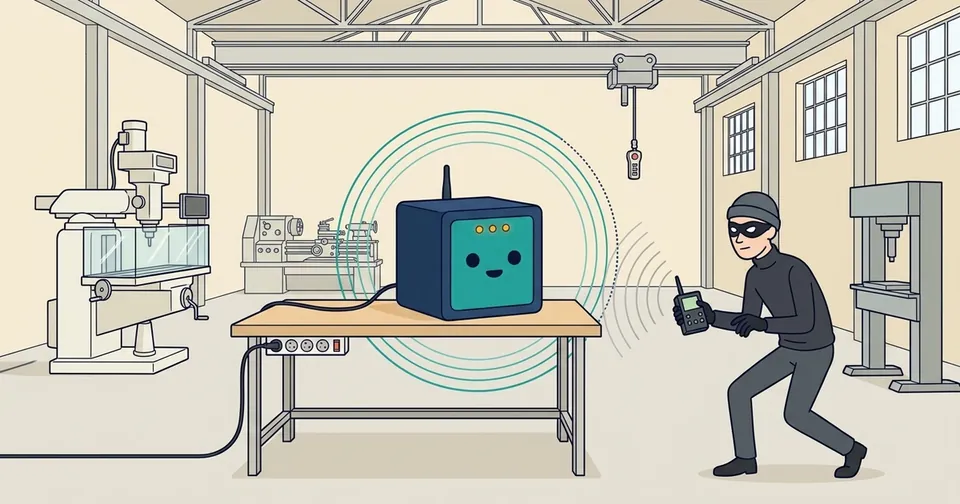
A wireless network that exists only to be attacked has nothing left to protect, and that is what makes it a good sensor, so we set up a honeypot that grants nothing, in the form of a fake access point which advertises its name but accepts no connection, and its only job is to make visible the gestures of someone who would take too close an interest in the Cube, our on-site decision unit (overview).
This article follows the one we wrote about the Flipper Zero and radio detection, but it goes down a level toward the concrete, on a case we really tested on the bench before writing about it.
Four gestures and one goal
A consumer wireless attack tool has only a small repertoire of gestures against a network, and they look much alike from a distance, so it is worth naming them one by one because each leaves a different trace.
First there is reconnaissance, because the attacker listens and asks before anything else, and it calls out to find whether a given network is present, which your phone does too, but a probe that asks by name for an administration network where no such thing should exist is already information.
Then there is the fake network, or evil twin, because rather than entering yours the attacker can advertise their own under the same name and hope a device or a person connects to it by mistake, and its signature is simple to state because it is our network name broadcast from a transmitter that is not ours.
There is also the connection attempt, because the attacker can try to get in for real by starting the authentication and association exchange, and against our decoy this attempt never succeeds for a reason we give below, but the attempt itself, aimed at our access point, is what we want to see.
And finally there is the forced disconnect, because the attacker may seek not to enter but to evict, and deauthentication frames sent in bursts tear down existing links to force a reconnection one hopes to capture or simply to disrupt, and this attack looks like nothing at the radio level since the frames are valid, while it is entirely abnormal at the logical level.
A honeypot that grants nothing rather than a fortress
Faced with these gestures the instinct is to harden a real door, but we preferred to set up a door that is not one. The Cube hosts a decoy network whose name is chosen for each site, for instance a technical-looking name. The access point must be declared to the company's Wi-Fi intrusion detection system. The decoy is protected by a key no one knows, because it is drawn at random at start-up, it is long, and it is never shown nor transmitted nor written in the clear anywhere but in the volatile memory of the chip that produced it, so no legitimate device has to connect to it and no attacker will get in for want of the key, and this network has nothing behind it, no service and no configuration and no access to anything. Its usefulness is not to be a fortress but a wire stretched across the corridor, and whoever approaches the Cube by the wireless path trips over it and we know.
What it sees and what it does not do
The honeypot watches its channel, as a wireless intrusion detection sensor, or WIDS, would, and recognises the four gestures described above, so a probe that asks for the decoy's name, an authentication or association attempt aimed at it, the advertisement of its own name by another transmitter, and a burst of disconnects beyond a threshold, and each of these observations produces a timestamped event that travels to the Cube's trust anchor, the part that makes the decisions, over the same signed internal link as the rest of the system.
We also have to say what this mechanism does not do, because that matters just as much. It never grants access, because the decoy is a sensor and not an entry point, and it stays one even when it detects an attempt. It emits no forged frame, because it broadcasts only the ordinary signals of an access point that exists, and it fabricates no fake deauthentication and no fake probe and nothing that would resemble an attack turned back on the attacker. And it does not retaliate, because jamming or deauthenticating in return would be outside our role and unlawful on these bands in most countries, and we do not want to turn a sensor into a transmitter we would have to answer for.
The charge port as a sensor and not a door
The same principle extends elsewhere in a less visible way, because the Cube charges through a USB-C connector and the two data wires of that connector, which no one uses to exchange anything, are read in read-only through a resistor and a clamp by the Cube's guardian, and this passive reading makes it possible to tell apart, without ever opening any dialogue, the charging cable we supply and a commodity adapter and a computer and an enumeration attempt such as a hostile peripheral plugged in place of the charger would produce. Here again the port grants access to nothing and becomes a sensor of its surroundings, and knowing that the Cube is no longer on its usual cable is information we would rather have.
How we tested it
We are careful to describe only what we have seen work. Detection was first checked on the bench in a reproducible way, because the firmware carries a self-test that builds real wireless frames in memory and runs them through the same analysis path as frames received by radio, without emitting anything on the airwaves, and each of the four gestures triggers the expected alert there while a probe that asks for another network is correctly ignored, which shows that there is no obvious false positive. Then comes the real radio trial, where an outside bench, which is exactly the kind of tool one seeks to detect, produces the gestures while the Cube only recognises them, and the division of roles is clear because the tool attacks and the Cube observes, and nothing of that attacking tool appears in what we design or publish. The criterion we set ourselves is simple, because every gesture has to be logged and reported in under two seconds without any access having been granted.
What detection proves and what it does not
A honeypot that grants nothing and still lights up proves a gesture took place near the Cube but it does not prove an intent, because a probe may come from a distracted phone and a connection attempt from a misconfigured device, and that is why these events corroborate a decision without ever replacing it, since they feed a judgement made by the trust anchor. The limits deserve to be said plainly, because the decoy watches one channel at a time and spotting a fake network advertised on another channel calls for broader monitoring that still lies ahead of us, and like any radio device it is exposed to denial of service, since someone who wants to prevent rather than enter will manage by saturating the band, and the answer to that is organisational as much as technical.
What we make of it
We did not try to make the Cube impregnable by the wireless path, because that promise is never kept by those who make it, but we tried to make it impossible to approach quietly and to make the slightest attempt leave an exploitable trace reported where the decisions are made. A honeypot that grants nothing and a charge port that grants nothing are reliable sensors rather than attack surfaces precisely because of that absence of access, so we ship no offensive capability and no retaliation, and what we ship is a Cube that knows when it is being watched.