
Listen Without Being Able to Speak: Sentinel Diodes
· 8 min read
Lire en français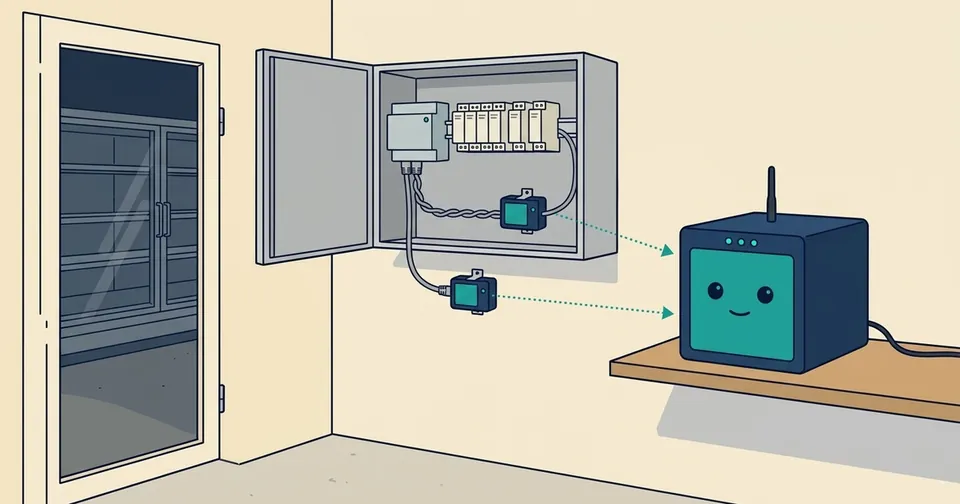
Listen without being able to speak, in brief
- Our Ethernet and serial sentinel diodes are satellites of the Cube. They listen to an existing cable, with no component able to transmit towards the refrigeration equipment.
- On Ethernet, they see who talks to the supervisor, when and how much. On a Modbus RTU bus, they also read the setpoints sent to the controllers, so they can judge the value of a command.
- They cannot disturb the installation with a command. But they cut nothing and may stay silent when they should not. Warranty and liability are therefore discussed before installation.
Fifth article in the series. The previous one, "A satellite for the store Wi-Fi", described a gateway that places the supervisor behind a single controlled door, opened for a window decided by the site manager. One question remained: what can be seen when someone holding valid credentials, stolen or not, walks through that door and sends a command?
Listen without being able to speak, the principle
Industry knows data diodes, which let information flow in one direction only, by hardware design, but their cost is not that of a store. We borrow the idea: to listen without being able to speak means reading what travels along a cable, while no component of the assembly can send anything back onto it.
The word diode is an image. These are not certified data diodes, which offer another level of assurance. Downstream, the Cube exchanges with an administration server, the operator's or ours depending on the contract, and that link carries only signed rules and logs, never a command towards the refrigeration. A sentinel diode sits on the existing cable, and what it observes travels up to the Cube by a separate path, in line with our habit of adding rather than modifying.
On the supervisor's Ethernet
The first diode goes on the cable linking the supervisor to its router, or to the gateway from the previous article. It relies on a passive Ethernet tap, which copies the signals to a monitoring port and sends nothing back onto the monitored link.
A fully passive copper tap, however, only works at 10BASE-T and 100BASE-TX. On a gigabit link it therefore brings the negotiation down to 100 Mbit/s, which is enough for a supervisor. It delivers two streams, one per direction. Fitting it briefly interrupts the link, and when the supervisor is powered over the cable (PoE), this must be checked.
Over HTTPS, the diode sees who connects, when, for how long and with what volume, but not what was changed. That already gives the time and the duration, two signals described in "Observe without reading". On a readable protocol, plain HTTP or Modbus TCP, it also recognises setpoint writes.
On the Modbus RTU serial line
Between the supervisor and the controllers there is often a serial line. The Modbus over serial line specification gives two-wire RS-485 as the most common, while RS-232 serves short point-to-point links. At Dixell, a brand of the Copeland group, an XWi70K controller joins the Modbus RTU line through an external XJ485-CX module plugged into its HOTKEY port. Some Danfoss installations use another bus, LON, which we cannot listen to. Your refrigeration contractor will tell you which one equips your display cases.
The second diode connects to this RS-485 bus, although some RS-232 equipment requires a different receiver. Our assembly starts with an RS-485 receiver with no transmit stage. Next comes an optocoupler, through which the signal passes as light, and then a microcontroller. An attacker in control of the microcontroller could make it report anything at all, but could not send a command to the controllers.
From the bus to the Cube
What the diode hears then reaches the Cube through a DIN rail module, the PUSR USR-DR164. This RS-485 to dual-band Wi-Fi converter (2.4 and 5 GHz) also acts as a Modbus RTU/TCP gateway. It runs on 5 to 36 V and withstands -40 to 85 °C. On its own, however, it is bidirectional. The diode, reduced to its receive stage, therefore stays between the bus and the module, so that nothing can be transmitted towards the controllers, even by a compromised module.
It is wired in a daisy chain, input and output on its terminal block, like one more controller. It has neither termination nor biasing, since the specification reserves them for the ends of the bus and for a single point on it. The shield is carried through without being connected to earth. Its receiver presents only a quarter unit load, plus the leakage of its protections, so it weighs little on the bus. Series resistors protect its input. A bus that is terminated but not biased may oscillate when idle, which is measured at installation.
Reading the value of a setpoint
On this bus, the diode mainly reads writes: which controller receives which value, in which parameter, at what time. It tells reads from writes by their function codes, 05 and 06 (a single output or register), 0F and 10 (several), according to the Modbus protocol specification. This is the value signal. It does, however, require the register map of each model, which not every manufacturer publishes.
The XWi70K manual gives three ranges. The defrost end temperature runs from -55 to 50 °C, the maximum defrost duration from 0 to 255 minutes, and the interval between two defrosts from 0 to 120 hours. The device accepts each value taken on its own, but it is their combination that makes a display case warm up. That combination is therefore what a rule watches, in the spirit of the FBI and CISA, who call for defining reasonable setpoint ranges, with an alert when they are exceeded. A combination never seen before on this display case, arriving at three in the morning, for instance, stands out at once.
Update of 11 November 2026. Ransom-ISAC published on 6 November its analysis of a commercial refrigeration site attacked on the night of 2 November. The controller was reachable from the Internet with its factory administrator credentials, and the report counts 743 parameter writes across 31 devices, setpoints raised to 110 °C and 150 °C and several commands silencing the alarms, with no attribution. These bursts of writes are the kind of signal this article describes, and the report also recommends checking temperatures with independent instruments.
Why listen to the bus
Nothing published so far names Modbus as the way in for the attacks. CERT-FR considers exposing management interfaces on the Internet contrary to good practice and asks for them to be withdrawn. We listen to this bus nonetheless, because it is where a setpoint reaches the controller, whatever path it took into the supervisor. On a LON bus, only the Ethernet diode then remains.
What this proves, and what it does not
What this proves. A sentinel diode designed without any transmitting component can neither write nor, therefore, disturb the installation with a command, even when compromised. It also provides a witness outside the supervisor, which matters when the supervisor itself is the one compromised. At the EFS, the French blood service, the incident was reportedly spotted by an on-call technician, and the alarm systems helped preserve the stocks.
What this does not prove. The diode cuts nothing. It reports to the Cube, which alerts the site manager. It is the gateway or a controlled socket that suspends incoming remote access. If the router being cut also carries the alarm reporting, the alarms first need a separate path. Suspension never targets the refrigeration.
A false negative remains possible. The diode only hears its own cable. An attack under way during the learning period would be learnt as normal. And a compromised supervisor could forge false controller responses, which is why an independent temperature probe remains useful on a critical site. An adjustment by the refrigeration contractor, announced within a granted window, triggers no alert and goes into the log and the daily summary. Outside a window, or beyond the permitted range, the alert is immediate.
Warranty, contract and liability
The manufacturer's warranty. Can a third-party device connected to the bus be invoked to refuse a claim? The answer depends on each manufacturer.
The refrigeration contractor. They must know that a device is listening and accept it. Ideally they would fit the diode themselves and offer it to their customers. Nothing changes in their interventions, and the witness also shows that their adjustments were within the rules.
The insurer. The question deserves to be put to them. An independent witness can help document a loss, without guaranteeing that it will be covered.
Whoever installs it. If the device disturbs the bus through an electrical fault, who is answerable? And if it saw nothing, who is at fault? Connection inside a cabinet remains the business of a refrigeration professional.
On these points, we recommend a legal review before any deployment.
The last article in the series, "The site manager's rules", describes what the Cube does with these signals: intervention windows, graduated alerts, suspension of remote access and the log.
Do you maintain refrigeration supervisors or Modbus buses, and see other constraints? Write to us at contact@trust-buster.com.
Sources
- CERT-FR, alert CERTFR-2026-ALE-012
- FBI / CISA, advisory of 5 November 2026 (PDF)
- Ransom-ISAC, analysis of the Copeland incident (6 November 2026)
- The EFS, quoted by Le Quotidien du Médecin
- Garland Technology, how passive network taps work
- Wikipedia, Network tap (passive taps, 10/100, gigabit)
- Modbus Organization, Modbus Application Protocol Specification V1.1b3 (PDF)
- Modbus Organization, Modbus over Serial Line V1.02 (PDF)
- Dixell, XWi70K controller manual (PDF)
- Danfoss, communications between controllers and the AK-SM 800A (PDF)
- Maxim, MAX3095 RS-485 receiver datasheet (PDF)
- PUSR, USR-DR164 module datasheet, RS-485 to dual-band Wi-Fi on DIN rail
This article provides general information and our analysis, not advice tailored to your installation. The Cube and its satellites are the solution we recommend. Any change to a refrigeration installation is decided with your refrigeration contractor, after checking the manufacturer's warranty, the maintenance contract and your insurance.