
A Satellite for the Store Wi-Fi
· 7 min read
Lire en français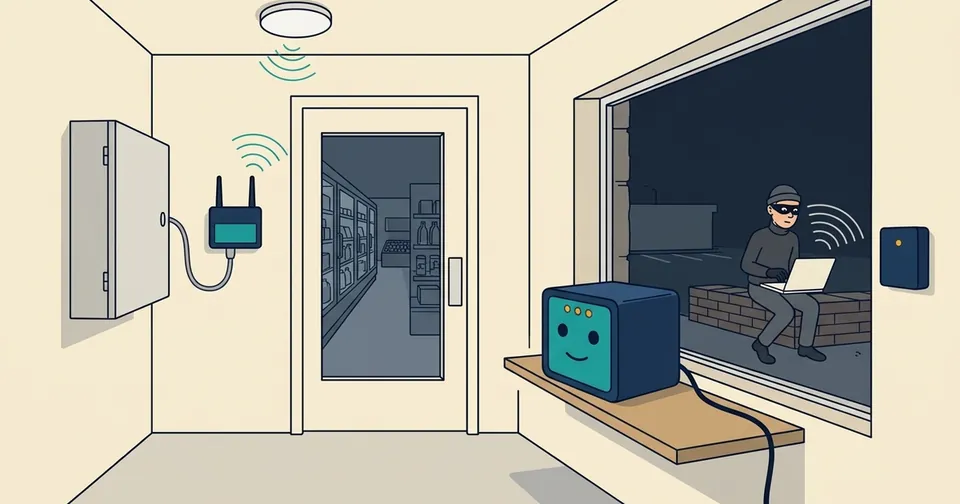
A satellite for the store Wi-Fi, in brief
- Our Wi-Fi gateway, a satellite of the Cube, connects to the store's Wi-Fi. It then groups the refrigeration equipment over Ethernet behind a single door.
- This door only opens to the refrigeration engineer within the window granted by the site manager. Every session goes into the log. Outgoing alarms are never deliberately blocked.
- Our Wi-Fi decoy reports local attempts without striking back. It does not, however, see an attacker with stolen credentials who comes through the open tunnel.
Fourth article in the series. The previous one, "Observe without reading", presents the Cube as the store's access supervisor. It describes the sentinel diodes, which observe a link without being able to speak on it. They thus read the time and duration of an intervention without opening an exchange.
Where we start from
The refrigeration supervisor (AK-SM at Danfoss, XWEB at Dixell, a brand of the Copeland group) is often connected in one of two ways. Either it shares the store network with the tills, reachable by anything that travels on it. Or the contractor has installed their own 4G router, as Dixell France recommends. The equipment is then well isolated. But the store no longer sees what comes in. What is gained in separation is lost in visibility.
CERT-FR considers the exposure of these interfaces "contrary to good practice". It therefore asks for them to be removed from the Internet and for access to be restored only through a secure VPN or a protected network. As an emergency measure, it does accept filtering the contractors' IP addresses. But this solution "must not be considered lasting".
The industrial remote maintenance gateways on the market already offer an outgoing tunnel, on-demand access and a log. Our gateway does not replace them. It adds the link to the Cube, which decides the window according to the site manager's rules. The Cube also keeps the evidence outside the store's network.
What a satellite for the store Wi-Fi does
The gateway is a small box placed near the supervisor. Upstream, it joins the store's Wi-Fi. Downstream, it offers an Ethernet port. The supervisor and the devices that talk to it are reconnected there. This is network segmentation at the scale of a store. Nothing reaches this segment any more without going through it.
Installation takes place during a visit by the refrigeration engineer, preferably during a planned intervention. They reconnect the supervisor to the box. Then they check with the site manager that the alarms still go out. No refrigeration setting is touched. It may, however, be necessary to review the supervisor's addressing, its network gateway and the server it sends alarms through. The refrigeration engineer does this or validates it.
On the refrigeration engineer's side, the gateway does not provide the access. The technician keeps their usual path. This is their company's VPN, the manufacturer's cloud or the retailer's bastion. This existing tunnel now ends at the box. The box lets it through or not according to the site manager's window. It logs every session and alerts outside the window. Strong authentication of the technician remains a matter for that access and its operator. Trust-Buster operates no remote access service.
Window and log
The refrigeration engineer's tunnel only passes during the intervention window granted in the Cube's rules. For example, from 8 am to 10 am this Tuesday. At night, the on-call person approves with a gesture on their phone. The last article details this. IP filtering is added to the window without replacing it.
Every session is traced: which account or which device, at what time, for how long. Within the window, no alert: the session goes into the log and the daily summary. Outside the window, on the other hand, or beyond the permitted duration, the alert is immediate. For the refrigeration company, this log is also a proof of service.
The gateway never deliberately blocks outgoing alarms. They always pass to the known destinations. Only remote maintenance therefore depends on the window.
A trap for local attempts
The October attacks came from the Internet. The decoy targets a local threat, less likely but cheap to watch for. It is, for example, someone trying their luck from the car park.
The box advertises a Wi-Fi decoy under a name specific to the site. No legitimate device has any reason to look for it ("admin" would attract staff phones). Nobody knows its WPA2 key. Association may succeed, but the key exchange fails. The decoy listens to one channel at a time and reports four families of events to the Cube:
- A device that looks for this network by its name.
- A connection attempt whose key exchange fails.
- A rogue access point imitating the decoy or the store, which requires knowing the list of legitimate access points.
- A burst of deauthentication.
This is detection only, with no jamming or retaliation. The decoy therefore disturbs neither the tills nor the customer Wi-Fi. Its link with the Cube is, moreover, signed.
Since the attack, many have placed decoys on the Internet that imitate the login page of these supervisors. According to Bitsight, they inflate the counts of exposed equipment. Ours only watches for what happens within radio range of the store.
Where the Wi-Fi sentinel diode fits
The Wi-Fi sentinel diode listens to beacons and management frames without ever associating. Its silence, however, rests on the software. Its radio could transmit, but its firmware prevents it. The Ethernet and serial diodes, for their part, physically have nothing with which to transmit. The Wi-Fi diode, on the other hand, avoids rewiring and switches nothing off.
It also watches the Wi-Fi the box depends on. Jamming or a burst of disconnections would indeed cut off remote maintenance. The store's Wi-Fi must therefore protect its management frames (802.11w, mandatory under WPA3). Pure jamming, however, remains indistinguishable from a radio fault.
If the gateway fails
The refrigeration carries on, because the controllers drive the cabinets locally. Remote maintenance stops, which is the safe behaviour. The refrigeration engineer then reconnects the old path while the box is replaced.
The alarms must not depend on the gateway alone. Otherwise, a fault in the box would silence them. We therefore recommend keeping a separate path, which often exists. It may be a contact alarm output, a transmitter or a contractor's router reserved for alarms. The Cube notices that the satellite for the store Wi-Fi has gone quiet. It reports it at once over its own cellular link, and the site manager's phone can also relay the alert.
The questions to ask before installation
Is the supervisor on Ethernet? Does it talk to other devices that must be moved with it? Is the Wi-Fi shared with customers or managed by the retailer? In that case it is often the retailer that must be called. Does the supervisor talk constantly to an online service? That flow will then have to be authorised separately, outside the window. Your refrigeration engineer usually knows the answers. The installation is, in any case, decided with them.
What the satellite for the store Wi-Fi proves, and what it does not
| Mechanism | Proves | Does not prove | Who answers for it |
|---|---|---|---|
| Segment and tunnel | No planned network path reaches the supervisor outside the gateway | The legitimacy of the session | The site manager, and us for the gateway |
| Window and log | When and for how long | What was done | The site manager |
| IP filtering | A known address | The right person | The contractor |
| Wi-Fi decoy | A local attempt | The absence of others | The site manager, alerted |
The first line assumes that the old wiring, a second Ethernet port, an old 4G router or a built-in modem has been removed.
The trap does not see an attacker with stolen credentials who comes through the open tunnel. This is the main limit, because such an attacker looks like the expected technician. What remains are the signals of the previous article: a longer session or an unusual time. If the traffic is read, a setpoint outside the site's habits is added to them.
In the next article, "Listen without being able to speak", we describe the Ethernet and serial sentinel diodes. They read the traffic without being able to send a command.
Do you operate or maintain remotely maintained installations? Write to us at contact@trust-buster.com. We will show you on a demonstration bench how these signals can be observed.
Sources
- CERT-FR, alert CERTFR-2026-ALE-012
- CTOL, Dixell France guidance and end of support for XWEB EVO
- Bitsight, data on attacks against supermarket refrigeration supervisors
This article provides general information and our analysis, not advice tailored to your installation. The Cube and its satellites are the solution we recommend. Any change to a refrigeration installation is decided with your refrigeration engineer, after checking the manufacturer's warranty, the maintenance contract and your insurance.