
The Site Manager's Rules: Alert, Suspend, Revoke
· 7 min read
Lire en français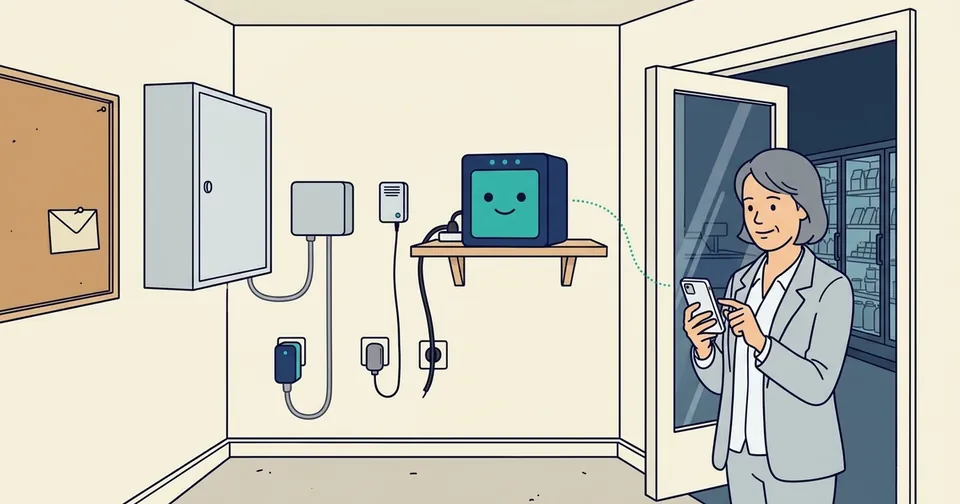
The site manager's rules, in brief
- The Cube applies the site manager's rules. They state who may intervene remotely, when and from where. With a serial sentinel diode, they also bound the range of a setpoint.
- Outside these rules, it alerts on three levels. It can suspend remote access, never the refrigeration, nor knowingly the alarms.
- Every decision goes into a local, chained log.
Sixth and last article in the series. The previous one, "Listen without being able to speak", described our sentinel diodes, which read the bus without being able to write to it. They see without cutting, but it remains to say who decides.
The site manager's rules, one sentence each
The manager of a store, a workshop, a plant or a warehouse generally has neither a security team nor time for a console, so each rule must fit in one sentence spoken aloud. For example: "the refrigeration company may connect on weekdays from 7 am to 7 pm, from its usual address. It must not raise the defrost end temperature above 12 °C, nor the maximum defrost duration beyond 45 minutes." These thresholds of 12 °C and 45 minutes are only examples, to be validated by the refrigeration contractor. Time and duration can be checked without reading anything. The range, on the other hand, requires reading the setpoint, which is the job of the serial sentinel diode.
The Cube first proposes rules based on the behaviour observed over the first days. An anomaly already under way would then be learnt as normal, hence the prior check of the configuration described in "Observe without reading". The site manager then writes the rules with their refrigeration contractor, who knows the monthly or seasonal interventions, and a simple interface lets them adjust the rules alone afterwards.
Revoking must be as simple as granting. Removing a technician means striking out a line. In the Cube, rules come down signed from the server, so a badly signed package is refused. Each package also carries a validity date, because a Cube cut off from the network could miss a revocation. Once that date has passed, it refuses all access and logs the fact as critical, and only break-glass then remains possible, until fresh rules return. The delay of a revocation is therefore bounded, at the cost of a general refusal if the Cube stays too long without news.
The intervention window, at night too
An on-call refrigeration contractor must be able to intervene at 3 am. Today, the secret often lies in a shared password. Since the attack, Dixell France has asked for it to be replaced by named accounts with an expiry date. We go further: at night, the supervisor's password is no longer enough. The technician is enrolled through an app they agree to install, which is negotiated with each refrigeration company. The window then opens by agreement, and their supervisor credentials, still required, are useless outside the window.
The agreement can come from a person on site, whose badge or phone is recognised by the Cube, just as for authorising a machine. It can also come from the site manager or the on-call person: the phone rings, they see who is asking and for how long, then accept or refuse with a single gesture. The window closes by itself.
With no network and nobody reachable, paper remains. The Cube then checks, offline, a break-glass QR code kept in a sealed envelope. Its use triggers a critical alert and leaves a signed receipt, handed to the server the next time an authorised phone passes by.
When a technician leaves, their phone is removed and they can no longer open a window. Named accounts are still better than a shared account. A phone that is lent or stolen, and unlocked, does however open what its holder could open, because the Cube proves that an enrolled device was present, not who was holding it.
Three alert levels
An alert that rings for everything ends up no longer being read, hence three levels, which the site manager adjusts.
| Level | Example | Proposed response |
|---|---|---|
| Information | Announced intervention, within a granted window. | Log and daily summary. |
| Warning | Request outside the time slot, or from an unusual address. | Immediate notification to the site manager, who accepts or refuses. |
| Critical | Setpoint beyond the permitted range, break-glass, several anomalies at once. | Immediate notification, and suspension of remote access if the rule provides for it. |
The range can only be seen when a sentinel diode reads the bus. An adjustment made in the supervisor itself, or on a LON bus, therefore escapes the Cube. The Cube ranks on these three levels its own events as well as the remote maintenance sessions reported to it by the satellites of articles 4 and 5.
Suspend remote access, never the refrigeration
The suspension provided for by the site manager's rules targets a single thing, which is the door through which one enters the supervisor from outside. The controllers keep regulating and the alarms keep going out. At the Établissement français du sang, the French blood service, an on-call technician and the alarms reportedly spotted the anomalies in time.
With the Wi-Fi gateway, it is enough to stop letting the refrigeration contractor's tunnel through, or to close it if it is open. With the contractor's 4G router, the only safe hold is sometimes its power supply, which the Cube can control through a relay. But it is only cut with the contractor's written agreement, and only if the site manager has put this router on the list of equipment that may be cut live. If this router also carries the alarms, cutting it would silence them. They must first be given a separate path, for example an independent alarm transmitter. CERT-FR also advises checking the insurance conditions before cutting the data flow to the refrigeration contractor. Temperature recording remains mandatory in France in frozen food storage premises, with records kept for at least one year. Cutting the data flow does not, however, remove local recording.
The Cube controls sockets and relays, quarantines a socket that someone tries to bypass, and logs every cut. The bounded opening of a supervisor's router reuses these same actions.
What the log proves, and what it does not
Each entry is linked to the previous one through a cryptographic fingerprint, and the Cube signs the whole. Removing or changing an entry therefore breaks the chain visibly, and a loss is itself recorded, as detailed in "A proof log". The signing key is protected in a secure element.
It proves that a window was opened, when, under which rule, with the agreement of which device and for how long, and which rule triggered a suspension.
It does not prove what the technician did in the supervisor, unless a sentinel diode read the setpoints that were sent. Nor does anything in it say who was holding the phone. And its time is that of the Cube's clock. The log itself has limits, which "A proof log" details, from sequence numbers to the chain head handed to the server. This log names technicians, and the badge or phone may also reveal the presence of employees, so it falls under the GDPR. The people concerned must be informed of it, and staff representatives consulted where required.
Who answers for a wrongful cut? The site manager chooses the rule. The rule templates we propose and their application can be checked in the log, and the sharing of responsibilities is set out in the contract. An unjustified suspension does not stop the refrigeration, but during a genuine breakdown it delays the intervention, which may cost goods. It is better to write into the refrigeration contractor's contract how they obtain an emergency opening.
Three questions to ask your refrigeration contractor tomorrow
These rules are only worth what is known about the installation, and three questions are enough to begin.
- How is our supervisor connected, through the site network, a 4G router, a built-in modem?
- By which path do the alarms go out, and is it the remote maintenance path?
- Who holds remote access today, and with which accounts?
Your refrigeration contractor generally knows the answers. What remains is to know what to do when refusal itself becomes a risk, which we addressed in "IAM at the end of the power cord".
The series: defrosting from afar, why the fridges stayed open, observe without reading, a satellite for the store Wi-Fi, listen without being able to speak and the site manager's rules.
Are you a site manager, a refrigeration contractor or a maintenance provider? We are looking for pilot sites, to be set up with your refrigeration contractor. Write to us at contact@trust-buster.com.
Sources
- CTOL, Dixell France guidance and end of support for XWEB EVO
- The EFS, quoted by Le Quotidien du Médecin
- CERT-FR, alert CERTFR-2026-ALE-012
- French Ministry of Agriculture, temperature recording for frozen food
This article provides general information and our analysis, not advice tailored to your installation. The Cube and its satellites are the solution we recommend. Any change to a refrigeration installation is decided with your refrigeration contractor, after checking the manufacturer's warranty, the maintenance contract and your insurance.