
Observe Without Reading: The Legitimacy of Remote Access
· 7 min read
Lire en français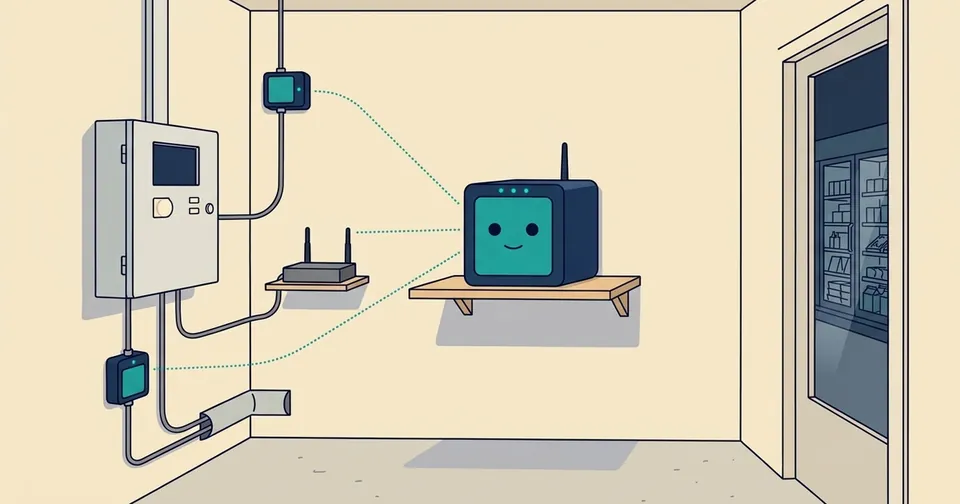
Observe without reading, in brief
- A remote intervention leaves traces. We observe them without reading the traffic: who, from where, when, for how long, how often, on how many sites.
- These traces are only meaningful when compared with the site's usual behaviour. Only the value of a setpoint requires reading what passes through.
- We describe the Cube, the site's access supervisor, then our sentinel diodes. These satellites observe the Wi-Fi, the Ethernet or the serial link without being able to write to it.
Third article in the series. The previous one, "Why the fridges stayed open", listed seven combined weaknesses and why every remedy runs into the realities of the field. It concluded that control will remain possible, but that nothing called its legitimacy into question.
The site manager's question
Take the manager of a site, whether it is a shop, a workshop, a factory or a warehouse. Last night, someone connected to the refrigeration supervisor. The manager has no way of knowing whether it was their refrigeration engineer. To help them, we propose to observe without reading what passes through.
After the attack, one often read that "the air gap is a myth, move to Zero Trust". Remote maintenance has indeed broken the isolation (the air gap) of these installations. But Zero Trust, where every access is verified, remains the name of a category. It does not say who will pay for it in hundreds of shops.
The US agencies are more modest. First, they isolate industrial equipment on a dedicated virtual network (VLAN). Then they restrict access to authorised addresses. They ask for the logs to be reviewed. They also recommend to "define and maintain reasonable setpoint limits" and to "establish alerting for deviations". We therefore entrust this work to a box that does not depend on the supervisor it watches.
Refrigeration remote maintenance: the signs of a legitimate intervention
A refrigeration engineer who works remotely has habits, even unwritten ones. They connect from their branch office, during the day unless there is a breakdown, for a few minutes. Above all, they rarely target dozens of sites in the same hour. These habits form the site's baseline behaviour. It then makes it possible to judge an OT remote access without reading its content.
| Question | What is observed | Must we read? |
|---|---|---|
| Who | The device or the account, if it can be identified | No |
| From where | Behind a tunnel, only the address of the router, the VPN concentrator or the cloud | No |
| When | The time, compared with the usual hours | No |
| How much | The duration and the volume exchanged | No |
| How often | The number of sessions per week | No |
| With what value | The setpoint written, for example a maximum defrost duration | Yes |
| On how many sites | The same action, the same night, elsewhere | Several sites must be seen |
The four signals of the previous article (time, value, duration, simultaneity) are found again in these seven questions. To see simultaneity, the administration server pools the alerts of several sites.
The baseline behaviour is learnt over at least one full week. It then lacks the monthly or seasonal interventions. As long as it remains thin, rules written with the refrigeration engineer are worth more. An anomaly already under way would, moreover, be learnt as normal. It is therefore better to check the configuration first, in particular the defrost ranges, as CERT-FR asks.
Observe without reading, then read only what matters
Observing without reading is not an affectation. Exchanges with the supervisor are increasingly encrypted, though not always on older models. Yet the metadata remains visible. It is enough to spot many unusual behaviours, without touching the refrigeration settings.
That leaves the value. Temperatures pushed up to 50 °C on some sites cannot be guessed from the duration of a session. Part of the setpoints can be read in clear on the serial link. This link connects the supervisor to its controllers, often over Modbus RTU. Only part of them, because defrost schedules and coordinated functions live in the supervisor. On the bus, they only pass as start commands. No public source names Modbus as the way the attacks got in. The point is only to read there what the supervisor has ordered.
The sentinel diodes
The Cube is a small box placed in the plant room. It sends its logs and alerts over its own cellular link, and the site manager's phone can act as a relay. Here, it serves as the site's access supervisor, not to be confused with the refrigeration supervisor. It does not regulate the cold, but watches who accesses those who regulate it. It relies on satellites called sentinel diodes, because they observe without being able to write.
The word diode is an image. These are not certified data diodes: they do not claim that level of assurance. Downstream, the Cube talks to an administration server, the operator's or ours depending on the contract. This link carries only signed rules and logs, never a command to the refrigeration.
Three sentinels, from Wi-Fi to the serial bus
The Wi-Fi sentinel spots the devices that associate, without decrypting the traffic. It listens to 2.4 GHz, channel by channel, but sees neither 5 GHz nor a wired supervisor. A radio, however, can transmit: its silence rests on the software. We therefore place it in the family for its role.
The Ethernet diode sits as a passive tap on the supervisor's cable. It sees the sessions, their origins and their durations, without being reachable on the network.
The serial diode connects to the RS-485 link when the controllers speak Modbus RTU. Its circuit has no transmit stage. A one-way optocoupler links it to the Cube. The RS-232 of some equipment, however, requires a different receiver.
For Ethernet and serial, on the other hand, the one-way direction rests on the hardware. No component of the circuit can transmit. The diodes switch nothing off. If the site manager has provided for it, another satellite suspends incoming remote access. It never targets the refrigeration or the outgoing alarms. A controlled plug, moreover, only switches off running equipment if it appears on the site manager's list, that of the equipment that can be cut while running.
Which satellite for which existing setup
The Cube adapts to the existing setup, which your refrigeration engineer can describe.
- On the shop's Wi-Fi: the Wi-Fi gateway of article 4, with the Wi-Fi sentinel as a complement.
- Over Ethernet: the Ethernet diode, which does not see the setpoint when the interface is encrypted.
- Controllers on Modbus RTU: the serial diode, which reads the setpoints but without knowing who gave the order.
- The contractor's 4G router: an Ethernet diode behind the router. With the contractor's written agreement, a controlled plug is also added on its power supply.
- Manufacturer cloud: an Ethernet diode on the outgoing side, the technician's identity remaining known to the manufacturer alone.
A word of caution: switching off a 4G router that also carries the alarms switches them off with it. They therefore first need a separate path. On large sites, bastions and industrial probes already do this work, with a dedicated team. We are aiming at the site that has neither.
What observation proves, and who answers for it
Observation proves an anomaly of behaviour, not an intention. A session at three in the morning may be a genuine breakdown (false positive). But a session at ten o'clock, from the usual address, may come from an attacker (false negative).
An announced intervention within a granted window triggers no alert. It goes into the log and the daily summary. Outside the window, on the other hand, or beyond the permitted span, the alert is immediate. The false positive then costs a call to the refrigeration engineer, then a gesture to acknowledge it on the phone. The false negative is more serious. An attacker who imitates the baseline behaviour escapes the metadata. Observing without reading therefore has its limits, and reading the setpoint reduces this risk without removing it.
Who answers for it? The refrigeration engineer remains responsible for their interventions, and the site manager for their rules. Our satellites keep two promises: being unable to write, and faithfully logging what they have seen. Our commitments on these two points are therefore set out in the contract.
The next article, "A satellite for the store Wi-Fi", details this frequent case.
Do you know how your supervisor is connected, or would you like to know? Write to us at contact@trust-buster.com.
Sources
- CISA, FBI, HHS, USDA and DoT, "Hardening Industrial Refrigeration and Cold Chain Monitoring Systems" fact sheet of 5 November 2026 (PDF)
- CERT-FR, alert CERTFR-2026-ALE-012
- IT-Connect, the supermarket cyberattack and the 50 °C defrost setpoint
This article provides general information and our analysis, not advice tailored to your installation. The Cube and its satellites are the solution we recommend. Any change to a refrigeration installation is decided with your refrigeration engineer, after checking the manufacturer's warranty, the maintenance contract and your insurance.