
Cutting the Power Is Not an Emergency Stop
· 8 min read · Updated
Lire en français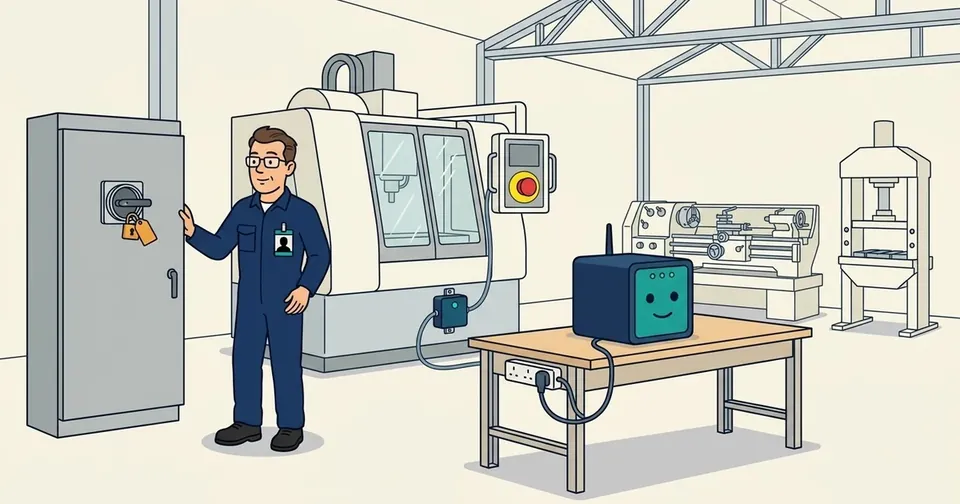
When we present Trust-Buster to people we know who work in this sector, the first objection is almost never technical in the sense IT people mean it, because it fits in one sentence, often asked with some suspicion, which is "you can cut the power to a machine, so you are doing machine safety, so show me your performance level". The question is fair, and we would rather answer it plainly, because no, we do not do machine safety in the functional-safety sense, cutting the power is not an emergency stop, and that is precisely why our device is designed the way it is.
This article is for operators, security managers and electricians wondering where electrical access control sits next to the personnel-protection devices they already know.
Two words, two trades
English has two words, safety and security, and French has sûreté and sécurité, but French usage mixes them, and the personnel-protection standards themselves are titled "safety of machinery", so we fix our vocabulary for the rest of this article. Safety protects people and property against failures, errors and the hazards of the machine itself, with an emergency stop, an interlocked guard, a light curtain or a safety relay. Security, in the sense we use it, protects against unauthorised use, malice and bypass, and it answers the question of who is allowed to start this equipment, when, and how to prove it.
Both disciplines have their standards, methods and owners. Machine safety relies on a risk assessment and on safety functions whose reliability is demonstrated, typically under EN ISO 13849-1 (performance levels, PL) or IEC 62061 (safety integrity levels, SIL), while industrial system security relies on other frameworks, first among them the IEC 62443 series. The two increasingly meet, and the new European Machinery Regulation, applicable from 20 January 2027, makes the meeting mandatory by requiring that safety functions cannot be compromised by malicious action, but meeting is not merging.
What our device is not, starting with the emergency stop
To avoid any misunderstanding, we would rather list what we do not claim than leave the reader to guess.
It is not an emergency stop. An emergency stop meets precise requirements (EN ISO 13850), because it is accessible, it overrides every other command, it acts according to a stop category chosen by the risk assessment, and it must be deliberately reset. Stop categories 0, 1 and 2 are defined by EN 60204-1, and EN ISO 13850 refers to these categories for the emergency stop. A socket driven by an access rule can cut the power and restore it, but it meets none of these conditions, and it must never be presented as one.
It is not lockout. Electrical lockout, described in France by the NF C18-510 standard and elsewhere by equivalent lockout and tagout rules, requires a reliable separation from the energy source, a physical lock on the isolating device, identification of the installation and a verification that no voltage is present, whereas a remotely controlled relay, however reliable, offers neither visible separation nor padlocking, so nobody should ever work on a machine because the Cube, our on-site decision unit (overview), has switched it off.
It is not a safety function within the meaning of safety standards. Our effector, that is the module that opens or closes the power supply, is neither assessed nor certified under EN ISO 13849-1 or IEC 62061, and we never insert it into an existing safety chain, because it sits upstream, on the equipment's power supply, next to the protective devices and never in their place.
These three limits we write into our contracts and on our product pages, because in our view a sales pitch that left any doubt on this point would do more harm than good.
Why cutting power can create a hazard
It is tempting to think that it is enough to cut the power for a machine to be safe, and it often is, which is what makes the power supply interesting as a control point, but not always, and the exceptions are exactly the ones a safety manager cares about.
Uncontrolled stop. Abruptly removing energy from a running machine is a category 0 stop in the sense of EN 60204-1, and for a bench drill it does not matter, but for a machine with an axis holding a load, an undersized fail-safe brake, a workpiece held by vacuum or a thermal process that must run to completion, the interruption may create the very risk one wanted to avoid.
Restart when power returns. EN 60204-1 requires that a machine does not restart dangerously on its own after a supply interruption followed by restoration, and EN ISO 14118 deals more broadly with preventing unexpected start-up. Many machines comply, but not all do, especially in older equipment, laboratories and shared workshops, so a device that cuts and then restores power must be designed never to become the cause of an unexpected restart itself.
The electrical installation. Inserting a switching device on a cabinet outgoing circuit means modifying an installation, with everything that implies in terms of calculations, selectivity, protection of persons and updated documentation, and it is not a trivial act, nor one we perform alone.
What we drew from this in the design
These findings did not lead us to give up on power-supply control, but to constrain it, and four principles follow, which we present as deliberate choices rather than general truths.
Authorise start-up rather than interrupt. By default, our device governs the authorisation to power up, not the stop, so equipment that is already running and falls outside its rule triggers an alert and not a cut, unless it appears explicitly on a list of equipment that may be cut while running, drawn up and signed with the operator after examining what an interruption would cause. That list holds a lamp, a microscope, a glue gun or a soldering iron, in short what is handheld, has a standby mode and is used to being switched off, and we know very well that in a workshop things are not always switched off properly, but if it is your installation you may choose to leave the microscope powered until someone comes and presses its button.
Come back powered off. After a mains failure, our enforcement points come back with the power off, and returning to service is an authorised act, never a side effect, because we preferred that a power return leaves the machine off, even at the cost of one more action, rather than hand control back to equipment whose restart behaviour we do not know.
Observe before arming. Every deployment starts in Observation mode, which detects, logs and alerts without ever cutting, and during that period the real behaviour of the equipment is measured, and the decision whether to go further is taken one machine at a time, as we describe in What the Cube Knows About Your Machines. Many sites never do, and that is a perfectly honourable outcome.
Stay on the socket or a dedicated circuit. Our operational effector currently acts on single-phase 230 V supplies, as a controlled socket or a DIN-rail module, while a hard-wired three-phase machine requires a study, a qualified electrician and an update of the installation file, so we handle it case by case, and we do not sell it as an off-the-shelf product.
What about substantial modification?
Regulation (EU) 2023/1230 defines a substantial modification as a change not foreseen by the manufacturer, made after the machine was placed on the market, that creates a new hazard or increases an existing risk to the point of requiring new protective measures, and whoever makes it becomes, under the Regulation, the manufacturer of the modified machine.
A device placed upstream of the power supply, which touches neither the control system nor the safety functions of the machine, is not in principle meant to fall into that category, and this is one of the reasons we stay at the boundary of the equipment rather than entering it, but we would not turn "in principle" into a certainty, because the answer depends on the machine, its operating mode and what a power cut does to it. It is a question to raise during the risk assessment, with the person responsible for the machine's conformity, and not one to settle in a brochure.
Complementary rather than competing
In the end it seems fairer to describe our device as a layer added to existing protections, and one that actually helps them, because a lockout remains a lockout, but the Cube's log can show that no authorised power-up occurred during it, an emergency stop remains an emergency stop, but knowing who started the machine ten minutes before someone had to press it sheds light on the incident analysis, and an electrical qualification is still issued by the employer, but its expiry date can become a rule instead of a line in a spreadsheet.
That is the fit we are looking for, and it is also why we insist that the decision to arm a piece of equipment stays with the operator, with a named safety referent on their side. Safety remains the business of those whose trade it is, and being able to cut the power to a circuit changes nothing about that, because our role is to give them what they lacked until now, namely a verifiable answer to the question "who powered this machine, and were they allowed to".
Sources
- Regulation (EU) 2023/1230 of the European Parliament and of the Council of 14 June 2023 on machinery, Article 3(16) (substantial modification) and Article 18. EUR-Lex
- EN 60204-1:2018, Safety of machinery, electrical equipment of machines, part 1: general requirements (stop categories, protection against supply restoration).
- EN ISO 13850:2015, Safety of machinery, emergency stop function, principles for design.
- EN ISO 14118:2017, Safety of machinery, prevention of unexpected start-up.
- EN ISO 13849-1:2023, Safety of machinery, safety-related parts of control systems, part 1: general principles for design.
- IEC 62061:2021, Safety of machinery, functional safety of safety-related control systems.
- NF C18-510, Operations on electrical installations and in an electrical environment, prevention of electrical risk (France).