
Remote Access and Physical Access: Two Different Problems
· 6 min read · Updated
Lire en français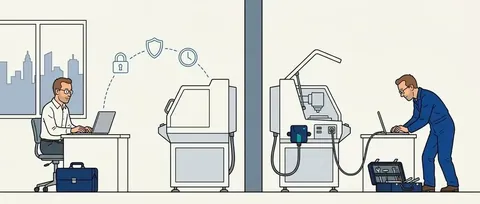
Same technician, same effects, but two separate forms of management, because securing remote access to a piece of industrial equipment and controlling physical access to that same equipment are two different problems, and neither one covers the other. A bastion, that is the jump server through which sensitive connections are routed so that they can be controlled and recorded, protects the session of the technician connecting from another site, but it says nothing about that same technician standing in front of the cabinet the following Tuesday.
These two subjects are regularly confused, and the confusion is costly because people buy one believing they are dealing with the other, so here is what each one covers as far as we know.
What secure remote access covers
Let us begin by describing it properly, because it is a demanding discipline and one the model describes well. A serious remote access set-up (bastion, application gateway, access broker) handles a complete and coherent chain.
The requester's identity is federated with the operator's directory or the service provider's, with multi-factor authentication, so we know who is connecting, and the proof is cryptographic.
Access is granted on demand and for a bounded period. The manufacturer's account does not exist permanently, since it is activated for one remote maintenance intervention, on a designated piece of equipment, during a defined window.
The session is supervised. What was done is recorded in full, sometimes with the ability to take it over live or to cut it off, and this is the most useful thing privileged access management brings, namely a usable trace.
The path is controlled. The connection does not cross the architecture end to end, because it stops in the demilitarised zone (DMZ) at level 3.5, where a protocol break takes place, and a jump host takes over towards the target system. Outbound-only connectivity, recommended by ANSSI and CISA alike, completes the set-up.
And the scope is restricted. The technician only reaches the equipment they have been mandated for, not the workshop network.
This is solid, and an industrial site that does not have it has a more urgent problem to solve than the one this article is about.
What the bastion does not cover
Now let us take the same technician, in a different situation.
They take a plane and arrive on site, they open the cabinet, they plug their laptop into the programming port on the front panel, and they do exactly what they would have done remotely, sometimes even with the same software, with the same rights on the PLC and the same ability to reprogramme it.
The bastion saw nothing, because it was not on the path.
This is not a flaw in the remote access product, since it does exactly what it was designed for, and blaming it would be absurd, so it is a question of scope. Privileged access management covers the manufacturer's remote access, but their physical access, same person and same service, is most often covered by no technical measure at all, even when a normative requirement addresses it.
And this is not a laboratory hypothesis, since on most of the sites we know physical intervention remains the main path by which a level 0 or level 1 device gets modified, because such equipment cannot be configured any other way.
Remote access and physical access, line by line
| Secure remote access | Controlled physical access | |
|---|---|---|
| The subject | A session opened from outside | A person present in front of the equipment |
| The path | A network conduit, drawn in the architecture | A door, drawn nowhere |
| The enforcement point | Bastion, gateway, protocol break at level 3.5 | Actuator on the power supply or the physical interface |
| The proof of identity | Federation with a directory, multiple factors | Cryptographic challenge on a secure element carried by the person |
| The proof of use | Session recording | Signed log of power-ups, cable connections and refusals |
| The network dependency | Total, by nature | None, because the decision is local |
| What it sees of the technician on site | Nothing | What goes through the power supply or the controlled interface |
| What it sees of the remote technician | Everything | Nothing |
The two set-ups are complementary and disjoint, so when you secure one you do not gain the other as a bonus effect, because a technician standing in front of the machine does not open a remote session to reach it, but uses the front-panel port, and often other access points as well, which makes the problem worse rather than solving it.
Why the confusion exists
Three reasons, two of which are legitimate.
The vocabulary is identical. Access control, identity, authorisation, privilege, session, revocation, both fields use the same words for different objects, and a buyer reading two brochures sees the same thing twice.
The Purdue model does not distinguish between them, since it does not describe the person at all. As we saw in the third article of this series, Long Purdue, only one of the two paths appears on the diagram, so the other has no name, and what has no name cannot be compared.
And there is a less admissible reason, because it is commercially tempting to let people believe that one product covers both. Nobody is really lying, but a feature table that ticks "access control for industrial equipment" without specifying which kind leaves the buyer to fill in the blank on their own.
The case that brings them together
There is one situation in which the two set-ups meet, and it deserves to be laid out because it is common.
The manufacturer's technician intervenes remotely for a diagnosis, concludes that a component needs replacing, and comes on site the following week, so same intervention, same work order, same person, and two paths.
An operator who governs this case well ought to be able to answer a simple question, which is whether the work order is the same object in both systems. In other words, are the authorised window, the designated equipment and the verified clearance consistent between the remote session and the site visit, or are they two unrelated authorisations?
In almost every case we know of, they are two unrelated authorisations, because the bastion knows a technical account and a time window, while the site reception knows a name and a visitor badge, and nothing links the two until an incident occurs. We described what a site visit implies on the operator's side in External Contractors: Who Touches Your Machines?.
That is probably where the real work of the coming years lies, and it will be done neither by the remote access players alone, nor by us alone.
Where we stand
We do not do secure remote access and we have no intention of doing so, because it is a demanding discipline, occupied by competent players, and the boundary between levels 3 and 4 in all likelihood remains the control that weighs most in your architecture. In small shops without a bastion, a satellite can condition the provider's existing access without replacing it.
We do the other path, that of the person who is present, on equipment that has no screen, no identity and no network, with a decision rendered locally even when nothing else is responding, and it is because these two paths, remote access and physical access, remain two different problems that we prefer to say clearly which of the two we address.