
Purdue Diligence: The Purdue Model in Ten Minutes
· 7 min read · Updated
Lire en français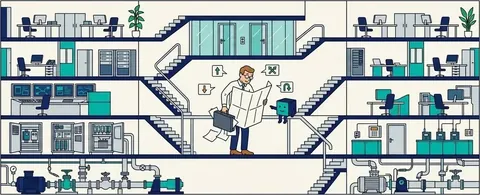
The Purdue model organises industrial systems into six levels numbered 0 to 5, to which practice has added a demilitarised zone inserted at level 3.5, and since it was published in 1992 and remains the common language of the shop floor and the architecture board alike, knowing which level each of your systems sits at, and who is allowed to talk to whom, is the starting point of any discussion about access to your machines.
We cite it because it is frequently referred to in the literature, and sometimes used as a sales argument, without necessarily matching its definition, so here is the short version for anyone arriving in the industrial world from business IT and cybersecurity, ahead of the two following articles in this series, which look at what the model does not see and at the link it is missing.
Where it comes from, and what it was aiming at
In 1992, Theodore J. Williams and the Purdue University consortium published a reference model for computer-integrated manufacturing, the Purdue Enterprise Reference Architecture or PERA, and the context is the computerisation of factories, long before Industry 4.0, because management systems were beginning to be connected to production systems and nobody quite knew how to describe the whole.
The idea is to organise the environment into distinct functional levels, each with its own role, its own systems and its own stakeholders, and it is not a security architecture, since the word barely appears in the original project, but a data flow model intended to bring order to a factory and to get people talking to one another who did not share the same vocabulary.
That origin explains both its longevity and its limits, and above all it explains why the Purdue model was turned into a security framework through usage rather than by design, because it was there, its hierarchy was convenient and it offered an obvious place to put firewalls.
The six levels of the Purdue model
Level 0, the physical process
This is what produces, heats, turns and measures, so motors, valves, pumps, actuators and temperature, pressure or position sensors, and it is the world of contact with matter, the only level where energy is exerted on it, and therefore the one where any error made elsewhere ends up translating into physical risk. It is the level we seek to protect without residing in it, as we explain in the third article of this series.
Level 1, basic control
This is the equipment that drives level 0, that is to say programmable logic controllers, the hardened computers that run the control logic, field computers, regulators and intelligent electronic devices, and this is where the thing that decides a valve opens when a temperature exceeds a threshold resides.
It is also, often, the oldest level of the installed base, because a PLC installed in 2003 does exactly what it is asked to do and has no reason to be replaced, but it does not necessarily incorporate access control, since the security asked of it at the time was that of the service it provides, which is to do its job without wear and without fault, and not that of knowing who reprograms it.
Level 2, area supervision
These are the human-machine interfaces, the operator workstations and the control systems of a workshop or a line, where the operator sees the state of the process and acts on it, and technically we are already in the world of the general-purpose operating system, often a version of Windows whose update would mean stopping production.
Level 3, site operations
This is production management at plant scale, with manufacturing execution systems, data historians, batch management and scheduling, and it is the last level considered to belong to the industrial world, with industrial IT, machine-to-machine networking and the first mechanisms for identifying users.
Level 3.5, the industrial demilitarised zone or IDMZ
This level did not exist in the original model, because it was added by practice when the plant and the enterprise had to be made to talk to each other without being put in direct contact, and it is a buffer zone, the industrial DMZ, where industrial systems deposit data that management systems come to collect, with no flow crossing from end to end. It houses relay servers, replicated historians and sometimes unidirectional gateways that make the return path physically impossible, and this half-level bears a large share of the model's security burden, which explains why it is talked about so much.
Level 4, site planning
These are enterprise resource planning, logistics, resource planning and the site's business applications, and by this point we have crossed over to business IT, with network equipment that we know how to monitor.
Level 5, the enterprise
This is the group network, shared services, the internet connection and enterprise applications, in other words the world a conventional chief information security officer knows.
The operating principle
The model's implicit rule, as it is usually read, fits in a single sentence, because a level only talks to its immediate neighbours, so level 4 does not address a level 1 PLC directly but goes through level 3, which goes through level 2, and each boundary becomes a place where a control can be put, where traffic can be filtered, logged or refused.
It is this property that made the fortune of the Purdue model in security, because it turns a factory into a succession of compartments and gives a simple answer to a difficult question, which is where the firewall should go, and it is also why the first use of the model is an inventory, since you have to know what sits at each level before knowing where to filter.
How the frameworks use it
The model did not remain on its own, since it has been absorbed by more or less everything that matters in industrial security, after the ISA-95 standard, which describes the integration between enterprise and control systems, had already taken up its functional hierarchy.
IEC 62443 defines its zones, conduits and trust boundaries on the basis of Purdue, and a zone groups together assets sharing the same protection requirements, while a conduit is a controlled communication path between two zones, and part 3-2 of the standard lays down a strong rule, because all communication between zones passes through an explicitly defined and monitored conduit, which we detail in our reading of the standard.
NIST SP 800-82, the American guide to operational technology security, relies on it to describe its layered defence in depth, and the reference architectures of the major vendors derive directly from it, such as Cisco and Rockwell's converged architecture or Schneider Electric's secure reference architecture, while the SANS SCADA reference model overlays on the Purdue hierarchy the places to put firewalls, proxies, detection sensors and jump hosts.
And the "Zero Trust for Operational Technology" doctrine published by the US Department of Defense in November 2025 explicitly recognises the Purdue model and IEC 62443 as frameworks that remain authoritative for classifying OT systems, even though it then chooses another grid, which we discuss in the next article.
What to take away
Three things seem to us worth keeping if you are only to keep three.
It is a descriptive model before it is a prescriptive one, because its primary value is to say what exists, which system sits where and how data should flow, and the rest is a layer of usage.
It is the common language, because when a security architect says "the 3.5", an automation engineer immediately understands what they are talking about, and in a field where IT and automation understand each other poorly that is an underestimated quality.
And it describes systems, not people, since each of its levels relates one system to another system, which is consistent with what was asked of it in 1992 and is the starting point for the rest of this series.
Next in the series: the criticisms levelled at the Purdue model in recent years, because the industrial internet of things, the cloud and remote access short-circuit its hierarchy, but they all share a common point that is rarely noticed, and that is the subject of the second article.
Sources:
- Williams, T. J. "The Purdue enterprise reference architecture". Computers in Industry, vol. 24, no. 2-3, 1994, pp. 141-158. DOI: 10.1016/0166-3615(94)90017-5.
- Williams, T. J. The Purdue Enterprise Reference Architecture. Instrument Society of America, 1992.
- International Electrotechnical Commission. IEC 62443-3-2:2020, Security risk assessment for system design. Geneva: IEC, 2020.
- International Electrotechnical Commission. IEC 62443-3-3:2013, System security requirements and security levels. Geneva: IEC, 2013.
- National Institute of Standards and Technology. SP 800-82 Rev. 3, Guide to Operational Technology (OT) Security. September 2023.
- Department of War, Chief Information Officer. Zero Trust for Operational Technology Activities and Outcomes. 18 November 2025.
- Cisco Systems and Rockwell Automation. Converged Plantwide Ethernet (CPwE) Design and Implementation Guide.