
Long Purdue: The Link the Purdue Model Is Missing
· 9 min read · Updated
Lire en français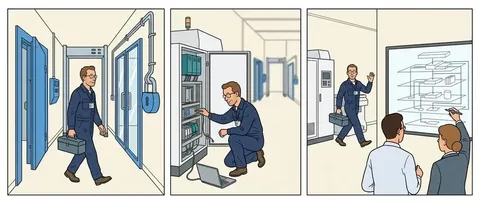
If we are asked where our system sits in the Purdue model, the answer is simple, because it sits nowhere, and it was created precisely to fill that gap, since the model describes systems talking to systems and is missing one link, the person standing in front of the machine, which we call in this article the Purdue missing link, for want of a better name.
The Purdue model has no level for the person
A manufacturer's technician who opens a cabinet and plugs a laptop into the programming port of a PLC, a programmable logic controller, has crossed no firewall, no demilitarised zone and no segmentation rule, and yet they have walked straight into level 1, the level of basic control, while their link meets, in our view, what IEC 62443-3-2 calls a communication path between zones, even though no architecture diagram draws it.
An ordinary Tuesday morning
A manufacturer's technician arrives on site at nine o'clock, reports to reception where he is handed a visitor badge, and a maintenance manager escorts him to workshop B, then he opens the cabinet of a drive, the electronic unit that sets a motor's speed, with the triangle key lying around in the toolbox, plugs his laptop into the front programming port, opens his manufacturer software, changes two acceleration ramp parameters, uploads, closes the cabinet and leaves at half past eleven.
Let us retrace his route from the point of view of the security architecture, because he crossed no firewall, he did not pass through the level 3.5 demilitarised zone nor open a session on a bastion host, no microsegmentation rule applied to him, no unidirectional gateway stood in his way and no detection system saw an unusual packet go by, since his laptop and the PLC talked one-to-one over a serial port, outside any network, so he walked straight into level 1 through a door and not a port.
And almost nobody today could answer three elementary questions:
- exactly which parameters were changed,
- on what contractual basis,
- and whether it was really he who changed them.
Why the model does not see it
This is not an oversight on the part of the Purdue consortium, and it would be unfair to present it that way, because the model was designed to organise the data flows of a computerised plant and each of its levels connects one system to another system, since level 0 is the physical process with its sensors and actuators, level 1 is basic control with its PLCs and controllers, level 2 supervises, level 3 manages operations, and so on, as we detailed in the first article.
Nowhere is there a level for the human present in the field, because that was not the question being put to the model in 1992, and the operator appears in it implicitly behind a level 2 interface as the user of a system, while the maintainer, the Purdue missing link we are talking about, does not appear at all, because they do not use a system, they open a cover.
The consequence is that every later extension of the model inherits the same blindness, since the zones and conduits of IEC 62443 describe communication paths between assets, Zero Trust verifies flows and microsegmentation ties policies to equipment identities, so none of these mechanisms has any hold over a person standing in front of an open cabinet, as we showed in the second article.
This is not an edge case
One might object that physical intervention is the exception and logical access the rule, but from what we observe it is rather the reverse, because on most industrial sites physical intervention is the predominant path for modifying a level 0 or level 1 device, since a large share of the PLCs, drives, controllers and test benches in service today cannot be configured any other way and you have to be standing in front of them, with the right cable and the right software, and at best a logbook is kept on site, or else one hopes to remember to record the day's intervention in the IT tool once back at the office, with all the approximations that entails.
These are, moreover, often the very devices that the operator has decided, often rightly, will never be connected to the IT network, which is what is called an air gap, precisely because the connection would create more risk than it would address, and the result is paradoxical, because the more isolated a device is from the network, the better protected it is against network attacks and the less it is governed at all, so isolation does not remove the need for access control but only the usual means of exercising it.
Nor are the causes for concern the ones people imagine, because a large share of the people legitimately standing in front of a machine do not belong to the organisation, whether temps, tier-two subcontractors, manufacturer's technicians who have never been on site before or service providers engaged by the maintainer itself, and they appear in no directory, while there is often no directory on the supplier's side to federate with, as we wrote about external contractors.
What the standards already acknowledge about physical access control
The most interesting point is that the body of standards says all of this, sometimes with disarming candour.
IEC 62443-3-2 lays down the rule that makes the subject unavoidable, because all communication between zones passes through an explicitly defined and monitored conduit, so if a connection exists it is a conduit and it is controlled, and a technician with a laptop and a programming cable is a connection between the outside world and a PLC, which nobody treats as such although it meets, in our view, the definition.
IEC 62443-4-2 goes further in its definition of a compensating countermeasure, since it gives the example of physical access control to a control room, intended to restrict access to a group of known personnel, and states its objective, which is to compensate for the technical requirement for the industrial system itself to uniquely identify people, so the standards committee writes that physical access control is what gets deployed when the industrial system is incapable of telling one human being from another, which is to say more or less always.
NIST SP 800-82 Revision 3 places physical security in its layered defence-in-depth model, and its appendix on tailoring controls to operational technology is unambiguous about control PE-3, because physical access controls complement OT security when electronic mechanisms are unable to meet security requirements, so two major frameworks, both compatible with Purdue, say the same thing, namely that when logical identification is impossible the physical takes over, and neither of them says how.
So the subject is not absent from the standards, since IEC 62443-3-3 includes a system requirement devoted to controlling the use of portable and mobile devices and IEC 62443-2-4 governs the practices of service providers, both of them squarely addressing the scene we have just described, and we have detailed elsewhere what the standard asks. These requirements describe what ought to be achieved, controlled use, verified authorisation and a trace, without saying by what means to achieve it on a device that has no screen, no identity and no network, and in practice they are met through procedures, a reception instruction, a paper register or a clause in the maintenance contract, but a procedure refuses nothing, measures nothing and signs nothing, so the result is a requirement that is formally covered and materially unverifiable.
The Purdue missing link, and where Trust-Buster stands
Here is our answer to the opening question, and it is somewhat uncomfortable to put into words, because we are at no level of the model but upstream of level 0.
Level 0 is the physical process, the motors, valves, sensors and actuators, but there is a precondition for the very existence of that level, which the model does not draw because it went without saying in 1992, and that is energy, because a machine without power does not produce, does not heat, does not turn, does not communicate and cannot be reprogrammed.
A policy enforcement point placed on the power supply therefore has a property that no software enforcement point can have, because it applies before the target exists functionally, while a software enforcement point runs after the target has started up and depends on its integrity, and no vulnerability in the device's firmware makes it possible to get around the absence of power, as long as the power really does go through that point and that point alone.
This is also what makes the approach agnostic, because it makes no assumption about the protocol, the firmware, the age, the manufacturer or the presence of a network stack, so the control applies in the same way to a PLC from 1998 and to a machine delivered last month.
If you prefer the vocabulary of zones and conduits to that of levels, the wording is sharper, because we draw the human conduit, this Purdue missing link, and we give it a rule, an enforcement point and a log, whereas it already existed and was governed by nothing.
The mapping, level by level
For those who have to present this to an architecture board.
| Purdue level | What usually protects it | What we bring to it |
|---|---|---|
| 5, enterprise | IAM, firewalls, endpoint detection | Nothing, this is not our field. |
| 4, site business planning | Same | Nothing. |
| 3.5, industrial DMZ | Protocol break, data diode, bastion host | Nothing, it is probably the most consequential control in the architecture and it is held by others. |
| 3, site operations | Segmentation, monitoring | Nothing. |
| 2, area supervisory control | HMI hardening, logging | Physical intervention on a supervisory workstation can be logged. |
| 1, basic control | Inline isolation, flow control | The human conduit to the PLC is drawn and governed. |
| 0, physical process | Nothing, in practice | The enforcement point is upstream, on the power supply. |
What we do not do
A reader who has just gone through these articles on Purdue will legitimately wonder whether we claim to replace their architecture, and the answer is no.
We do no network segmentation, so no industrial firewall, no microsegmentation and no east-west policy, and we do not hold the boundary between levels 3 and 4, because the demilitarised zone, the protocol break and unidirectional gateways are other trades, practised by serious players, and that boundary very probably remains the most consequential control in your architecture.
Nor do we provide a safety function, because cutting a power supply is, for us, a security control and not a certified function, and it is no substitute for an emergency stop, a lockout or a safety relay, as we have written in detail.
What we do fits in one sentence, because it is about controlling and proving who energises a piece of equipment, across an estate that has no screen, no identity and no network, including when nothing else responds, and we intend to offer other means of control at level 0 with serial, USB or BLE effectors, so as to be able to detect, identify, verify and authorise any intervention by a technician on the estate, but the only fully operational effector to date is the power cut.
The model is not missing a level
The temptation would be to propose an additional level, a "level minus one" for the human and for energy, and it would be elegant but probably wrong, because the Purdue missing link is not a tier in the hierarchy, it runs through it, since the same technician who opens a level 1 cabinet may, in the afternoon, log on to a level 2 supervisory workstation and plug a USB stick into a level 3 server, so it is an orthogonal axis and not a layer.
So the point is not so much to complete the diagram as to acknowledge that an architecture which describes only machines cannot, on its own, govern what people do.
Last article in the series: the same technician, with the same laptop and the same ability to reprogram, sometimes connects remotely from another continent, and that case is well handled, but by a different trade from ours, so we mention it to make the distinction quite explicit.