
What the Cube Knows About Your Machines
· 10 min read · Updated
Lire en français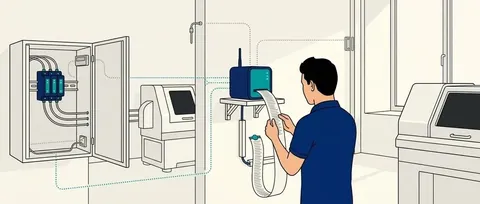
A smart meter costs around thirty euros and measures quite accurately what a machine consumes, but it does not know who was in the room. The Cube is our on-site decision unit (overview), and what the Cube knows about your machines comes from correlating consumption, enrolled presences and the sensors you already have to produce what none of the three sources provides on its own, namely an attributed usage log, which serves to recharge, to spot use outside scheduled hours or to prove later who started what. It does so in Observation mode, that is by watching and recording without ever cutting anything off.
Measurement, presence, correlation: activity reports as things happen
An off-the-shelf module clipped onto a cable measures consumption with sufficient precision, but it knows nothing of who was in the room, nor of what it was normal to consume that day, nor of what ought to trigger an alert.
What the Cube produces is of a different nature, because it is an attributed activity report, reasoned alerts and a signed log usable in an audit, and sensors are its raw material, not its product. That is also why we do not seek to manufacture sensors, but to read them in order to complete the Cube's decision, which consists in logging an authorised action, alerting on inappropriate use or an intrusion, and as a last resort only, if the operator has so decided, placing equipment in a protected state through a cut-off defined according to safety and security rules, as we explain in Cutting the Power Is Not an Emergency Stop.
Three input sources
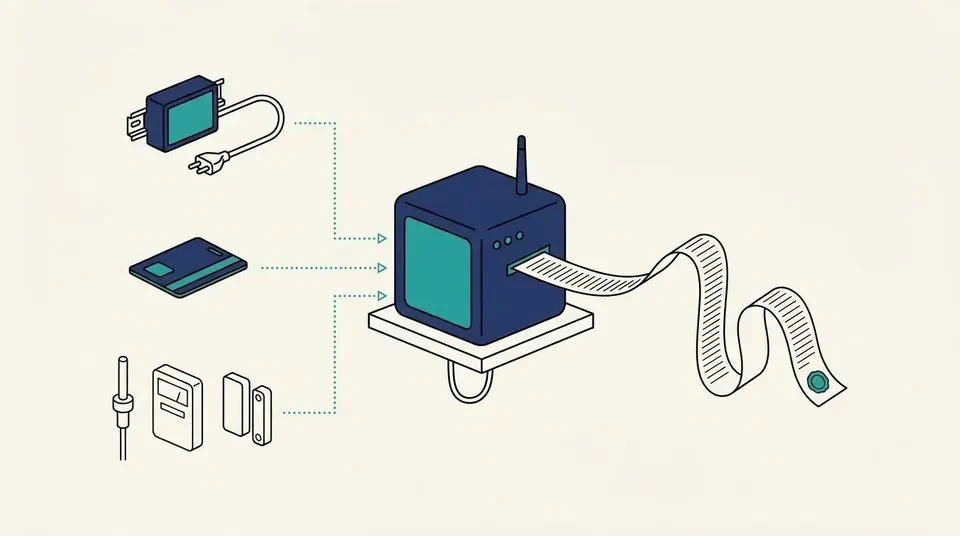
The effectors, first. These are the modules we fit ourselves on the equipment's power supply, and they have a useful particularity, since they measure and control at the same point, which makes it possible to move from observation to action without reinstalling anything on the day the operator decides to.
Presence, next, established by the Cube from the enrolled badges, phones or connected objects that enter and leave the premises and indicate the presence of known users.
And your sensors, if needed. This is the point we long underestimated in our own communication, because the Cube knows how to read sources it did not install, such as temperature and humidity probes, existing energy meters polled over Modbus, which is a common industrial protocol, door contacts, flow meters or points from a building management system (BMS) already in place.
On an instrumented site, a good share of the raw material is already there, but it has never been cross-referenced with anything else, because a temperature reading that lives in a supervision dashboard and an entry register that lives in a binder have never met.
Why control and measurement at the same point
A four-channel DIN-rail module, installed inside the electrical cabinet, brings four things at once.
Four circuits for a single device. Measurement and control on four outgoing feeders, with a single connection point and a single device to enrol, and the saving is real across an estate.
Measurement and cut-off inseparable. The same electronics observe and act on the same channel, so there is no configuration in which one circuit is measured and its neighbour controlled, and the report and the action concern the same object, by construction.
The device is out of reach. This is the point we insist on, because a module left in plain sight on a socket can be unplugged, reset or carried off, while the same module behind the closed door of a cabinet inherits the cabinet's protection. The residual risk we document elsewhere, namely that a factory reset restores the module's original behaviour, is much reduced when access to the module already requires opening a locked cover.
And the machine is not touched. The cabinet in which we fit the module is the distribution cabinet, not the machine's, so we stay at the boundary, on the feeder that powers the equipment and not on the equipment.
What a power curve tells
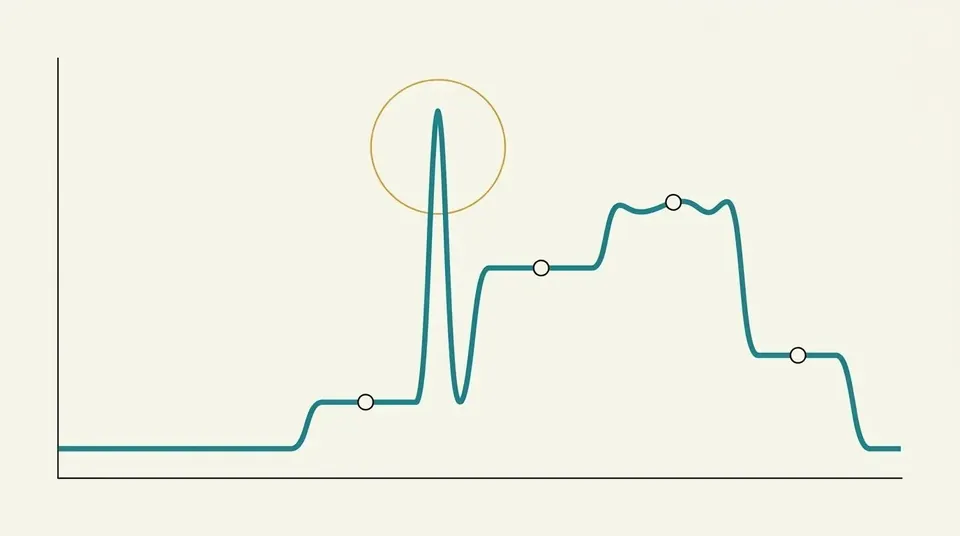
A machine does not consume uniformly, and the levels of its load curve are readable.
When fully stopped, consumption is zero or near zero, and it is the only unambiguous state.
On standby, it is low but not zero, because of the control electronics, the display or the cabinet ventilation. It is a stable level, specific to each machine, and it is the one most often mistaken for being off, because a "switched-off" machine that permanently draws forty watts is a machine that is on.
At start-up, a motor draws a current markedly higher than its rated current for a short moment, and that peak is a signature, because it dates the start-up to the second provided the measurement is frequent enough, and because it distinguishes a genuine start from a wake from standby.
Running idle, the machine turns without working, and under load it consumes more, with a gap that is generally clear-cut.
From these levels follow four pieces of information usable without interpretation, which are the number of start-ups, the time powered on, the time under load and the energy consumed, and the difference between the two durations is often the most telling figure, because a machine powered on for eight hours and under load for forty minutes is not the same management object depending on which one you look at.
What the Cube knows once it crosses the sources
Four situations emerge, and each calls for a different reading.
Attributed use. The machine is running and a single enrolled person is present throughout the period, which is the nominal case and produces a usable log line, with who, which machine, from when to when and how much energy.
Unattributed use. The machine is running and nobody is detected. Three explanations are possible and all three must be kept in mind, a scheduled cycle that requires nobody, a person present without an enrolled identifier or a remote start, so this is not an alert in itself but a line that calls for an explanation, and it is more frequent than one might imagine.
Presence without use. Someone came and the machine did not start, which is commonplace but useful for distinguishing a visit from an intervention.
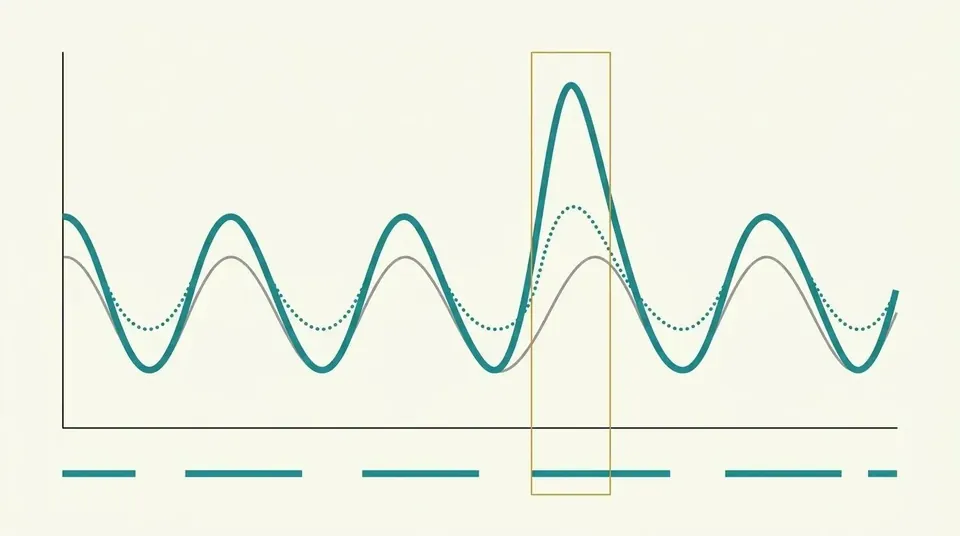
Change of state during a presence. This is the most interesting case, because nobody sees a thermostat being turned, but if the heating elements start drawing more while an identified person was on site, and nothing in the outside conditions explains it, a setpoint has probably moved.
And this is precisely where your existing sensors make the difference, because with consumption alone the inference is indirect and fragile, while with an indoor temperature probe as well, which you probably already have, the reasoning becomes clear-cut, since the setpoint temperature has evidently changed, at such a time, and here is who was there. We move from a hypothesis to an observation.
Establishing baselines
High consumption means nothing in itself, because a heater consumes more on a cold night, a pump when the level drops and a compressor in summer, so the usable signal is the gap between the observed consumption and the consumption expected under those particular conditions.
This requires measuring first the normal behaviour of each piece of equipment over several weeks, with its seasonal and weekly variations, and that is what Observation mode does, and that is why it takes time, because what the Cube knows about a piece of equipment after three days is not worth much.
A system that alerts on an absolute threshold is likely to produce false alerts all winter and to end up unplugged before spring, and a baseline that incorporates outdoor temperature is markedly finer than a calendar-based one, which is one more reason to read your sensors.
The inference scale
Here is the grid we are keen to set out explicitly, because this is where the gap lies between an honest use and an abusive use of this data.
| Level | Example | Status |
|---|---|---|
| Measured | 1,240 W at 14:32, badge B present from 14:10 to 15:05, 19.4 °C indoors | Raw data, not open to dispute |
| Established | The machine was powered on from 14:28 to 15:02, of which 22 minutes under load | Direct deduction from the levels |
| Inferred, high confidence | The machine was used, not merely switched on | Relies on a load threshold calibrated per piece of equipment |
| Inferred, moderate confidence | A setpoint was changed during this presence | Relies on a deviation from the baseline, and becomes high confidence if a temperature sensor confirms it |
| Not inferable | What the person did, what was produced, whether it was authorised, who exactly acted if several people were present | Never to be presented as a conclusion |
The last row is the one that matters to us, because it is the one a vendor is tempted to cross, and a report that states "so-and-so changed the thermostat" says more than the data allows. What it can honestly write is that "heating consumption deviated from the baseline by 34% at 14:40, that the indoor setpoint temperature rose by 2 °C over the same period, and that the people present were A and B".
The difference is not cosmetic, because the first wording does not survive a challenge, while the second one does.
What the Cube will never say
Everything the Cube knows fits in the grid above, so there remain things it will not say.
Power says the machine ran, not what it did, because no electrical measurement distinguishes a compliant part from a reject.
A shared circuit blurs attribution. Three machines on the same feeder, and you measure their sum, which is, incidentally, the concrete argument in favour of a four-channel module rather than one module per distribution board.
Two people present, no individual attribution. This is structural, and it is probably a good thing, because it makes the system poorly suited to individual performance monitoring, and we do not seek to make it suited to that.
A badge proves a badge. A lent badge produces a false attribution, dated and signed.
And the baseline can be fooled. Someone who knows the system can change a setpoint gradually, over several weeks, so that each deviation stays below the threshold, and we do not claim to detect that.
The legal question, which is not the same as before
Measuring that a machine ran is technical data, while measuring that a named person was present is personal data within the meaning of the GDPR, and combining the two to deduce what a person did and for how long falls under the monitoring of employee activity, which is not the same regime. We have detailed what that implies in Detecting Presence Without Monitoring Employees, and what the Cube knows about a person stops at their presence.
What makes such processing legitimate is its purpose, because recharging the use of a shared workshop is a clear and proportionate purpose, alerting on operation outside scheduled hours is one as well, while drawing up an individual productivity ranking is not, and a system that allowed it should not have been designed that way.
Three consequences follow, drawn at the design stage rather than in a usage policy.
Aggregation is the default mode. Reports are produced per machine, per period and per organisation, and named attribution appears only on a defined trigger, such as use outside scheduled hours, an anomaly or a reasoned audit request.
Retention periods are distinct. That of named correlations is short, while that of consumption data, which has nothing personal about it once detached from presence, follows your management needs.
And the system announces itself. Installing an observation system in premises where employees work requires, in France, informing and consulting the CSE, the works council, before installation and not after.
Why start there
For a large number of operators, this mode is already a sufficient result, without going as far as on and off access control, because they never needed a machine to stop, but they needed to know who had started it, and to be able to prove it eighteen months later.
This has a pleasant practical consequence, because a deployment in observation cannot, as long as nothing is armed, stop your production, so the question "and what if your box gets it wrong?" loses most of its weight, and with it a good part of the difficulty in getting a pilot accepted.
What you obtain nonetheless is an attributed usage log, detection of operation outside scheduled hours, a basis for recharging and the actual event rate per machine on your site, that is the data that allows you to decide, later and with full knowledge of the facts, whether it is worth arming anything at all.
And if you one day decide to do so, nothing needs reinstalling, because it is the same device, in the same cabinet, that was already measuring, and what the Cube knows already about the machine then allows that decision to be taken without haste.