
Who Is in the Room?
· 7 min read · Updated
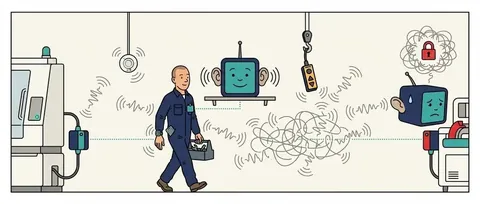
A dashboard announcing forty-seven devices detected this morning in a workshop six people walked through is not lying deliberately, because it is counting addresses, and modern Bluetooth and Wi-Fi devices change address every few minutes, which makes naive counting useless and makes one specific mechanism the difference between knowing who is in the room, for the badges you enrolled, and tracking nobody at all.
First of four articles on radio detection in industrial environments, and this one covers what you can learn passively, before any spectrum analysis or any anti-jamming logic.
Three questions people often conflate
Before protocols, a distinction that took us a while to phrase properly, because radio detection covers three needs with different means and different limits. The first is whether this badge is here now, which means listening for a known beacon and tracking its presence, and the difficulty there is not hearing it but telling real proximity from a relayed signal. The second is what is transmitting in this room, which means inventorying everything, known or not. The third is whether someone is blinding us, which means measuring the state of the spectrum itself. This article answers the first, the next one and the one after answer the others, and the fourth answers a question none of them can dodge, which is whether you are allowed to do any of it.
What a Bluetooth device says without being asked
Bluetooth Low Energy works by advertising, because a device that wants to be discovered emits, every few hundred milliseconds, a small packet containing its address, sometimes a name and sometimes service data, and these packets travel in the clear on three dedicated channels that any receiver can listen to without connecting to anything. That is what makes detection easy, since a simple Bluetooth card in listening mode sees smartwatches, earbuds, item trackers, temperature sensors, phones in discovery and the badges we have enrolled, and each packet comes with a measurement, the received signal strength or RSSI, which decreases with distance, and that is what creates the illusion of a distance measurement, and we will come back to why it is a poor one.
The problem everyone eventually discovers: MAC randomization
A naive system counts addresses and believes it is counting devices, and it is badly wrong, because modern devices, under what the phone makers call MAC randomization, draw a new address roughly every fifteen minutes, so to an outside observer a phone becomes a different device four times an hour, and anyone building a presence system on address counts will overestimate the occupancy of a room by a factor of four to ten and never notice, because the number looks plausible. But the mechanism has a property you can rely on, and it makes all the difference between an enrolled device and a stranger, because each rotating address is derived from a key exchanged once, at pairing, so whoever holds that key can verify that an apparently random address belongs to the device they know, while whoever does not holds only a sequence of unrelated numbers. The consequence is worth stating carefully because it cuts both ways in our favour, since enrolled badges stay tracked despite their address changes, because the key was handed to us deliberately by someone who agreed to be identified, while devices we do not know remain untrackable by construction, since the protocol makes it impossible without the key, whatever our intentions. That is a property of the specification rather than a privacy policy we wrote, and we consider it an advantage rather than an obstacle, and it also means that when someone asks whether our system tracks visitors' phones, the answer we can give is that it cannot, which we find a better answer than a promise that it does not.
Entering and leaving the room: the single-threshold trap
Deciding that a badge entered when its signal passes a value and left when it drops below produces an unusable system, because the measurement swings ten to twenty decibels when someone turns round, walks behind a machine or sets their badge on a metal bench, so a single threshold generates dozens of entries and exits per hour for a person sitting still in the room, and every one of them is an event someone has to look at. Three mechanisms fix this, and they apply to any system of this kind. The first is hysteresis, which means two thresholds instead of one, so you enter at one level and only leave at a markedly lower one, and the grey zone between produces no event at all. The second is a persistence window, because a badge is declared absent only after several consecutive missed advertising cycles and not on the first lost packet, so a burst of interference does not cut an access in progress, which matters when the consequence of cutting is a machine stopping mid-cycle. The third is temporal smoothing, which means working on a rolling average of recent measurements and never on the instantaneous value. Tuning these three is specific to each room, because a machine shop full of cast iron does not have the same signature as an electronics lab, and neither resembles an outdoor substation, and that is exactly what Observation mode exists to measure, since before anything is armed it produces the real event rate per day and per machine, on your site, with your people, and if the number is not liveable you do not arm that machine, which is a decision and not a failure.
What Wi-Fi adds, and where it stops
A Wi-Fi card in monitor mode, which means passive listening that joins no network, captures a class of frames that encryption does not protect, the management frames, such as access point beacons, client probe requests, association requests and deauthentication frames, and even on a WPA3 network these travel in the clear since they are what negotiates the connection in the first place. That is enough to spot three useful things. The first is an unauthorised access point in the room, such as a cellular box plugged into a cabinet or a phone tethering on a rack, and Bastille has reported a data centre case where a smartphone configured as a hotspot, paired with a dongle attached to a server rack, opened a data path running over the phone's cellular link that bypassed firewall, DLP and SIEM entirely, with no sophisticated tooling and nothing on the network seeing it. The second is a deauthentication attack, the most common Wi-Fi attack and an easy one to detect, because it shows as an abnormal volume of forced-disconnect frames from a single address, and it is worth noting that it fails against networks that enable protected management frames under 802.11w, which WPA3 does, assuming the estate supports it, which in an industrial setting it frequently does not. The third is an evil twin, an access point announcing a legitimate network name from a room where it has no business being. Where it stops is also worth saying, because for several generations now iOS and Android devices use a different address per network and randomise their probe requests too, so counting Wi-Fi addresses to count people is even less reliable than in Bluetooth, and unlike BLE there is no equivalent of the pairing key to rescue you, which means Wi-Fi listening is good for spotting infrastructure that should not be there and poor for knowing who is present.
What presence detection proves
| Mechanism | Proven | Not proven |
|---|---|---|
| Receiving a BLE advertisement | An emitter with this identifier transmitted in range | That its legitimate holder is there |
| Address resolution via the pairing key | This emitter is the enrolled device | That it was not lent or stolen |
| Signal strength with hysteresis | A plausible, sustained radio proximity | A real distance, because the signal can be relayed |
| Wi-Fi monitor mode | Abnormal activity or an undeclared access point | A complete inventory of devices present |
The second row is the one that matters operationally, because a badge proves a badge, and someone handing theirs to a colleague because it is quicker defeats every property in this article, so what still stands in the way in that case is the schedule, the persistence requirement, the integrity of the enforcement device, and a log that records the access under the legitimate holder's name at an hour when that person can say where they were, rather than the badge itself, and that is as close as we get to knowing who is in the room.
Next in the series, What an SDR Finds, about what a software-defined radio effector finds when you look beyond Bluetooth and Wi-Fi, and the structural limit that means it will never find everything.