
What an SDR Finds
· 6 min read · Updated
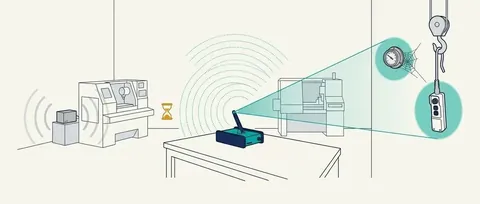
A single-channel software-defined radio, an SDR, cannot listen to a wide band all at once, because it sweeps, pausing a few milliseconds on one portion of the spectrum before moving on, and so it misses everything that transmits while it looks elsewhere, and that is a structural limit rather than a tuning fault, and it is the first thing to understand before buying anything.
Second of four articles on radio detection in industrial environments, after Who Is in the Room?, which covered Bluetooth and Wi-Fi presence detection, and this one goes beyond them.
What a software-defined radio, or SDR, is
An SDR is a receiver that does nothing on its own, because it digitises a raw slice of spectrum and hands it to a computer, which decides how to interpret it, so the same hardware listens to a gate remote, a temperature sensor, a contactless badge or a cellular modem depending only on the program you give it. That is what makes a dedicated listening effector realistic, since it comes down to an SDR card on a single-board computer, with the antenna suited to the target band, running software that decodes what matters and discards the rest, and we only ever use it to receive.
Choosing hardware, and a trap we fell into
| Hardware | Coverage | Note |
|---|---|---|
| RTL-SDR (about 30 euros) | about 24 MHz to 1.76 GHz | Best value by a wide margin, but it does not reach 2.4 GHz, so it sees neither Wi-Fi nor Bluetooth |
| HackRF One | 1 MHz to 6 GHz | Covers everything, including 2.4 and 5 GHz, with an 8-bit converter that makes it less sensitive |
| Airspy R2 | 24 to 1800 MHz | Better reception than the RTL-SDR on the same band |
| LimeSDR / USRP | up to 3.5 to 6 GHz | Considerably more expensive, laboratory quality |
| KrakenSDR | 24 to 1766 MHz | Five receivers synchronised on one clock, for direction finding |
The trap is in the first row, and we fell into it like everyone else, because many projects start with an RTL-SDR expecting to monitor all radio and then discover that the most interesting band in an industrial setting, the 2.4 GHz where Wi-Fi, Bluetooth and Zigbee live, is precisely out of its reach. Serious wideband listening therefore needs at least two radios, one for sub-GHz and one for 2.4 GHz, and any product or project claiming full coverage on a single thirty-euro receiver has, in our view, not looked closely at its own specification.
What you actually find
On the sub-GHz bands the reference tool is rtl_433, a free decoder that recognises over a thousand commercial sensor and remote protocols across 315, 433, 868 and 915 MHz, and what it reveals in a workshop is usually a surprise, and rarely a pleasant one, because you find the following.
- Temperature and humidity probes fitted by a contractor during a survey and never removed
- Crane and gate remotes, often on fixed codes
- Door and window sensors from a previous alarm system
- Weather stations, and tyre pressure sensors from vehicles in the yard
- And, with some regularity, a piece of equipment that appears on no inventory at all
That last category is the interesting one, because an estate whose emitters are unknown is an estate whose asset inventory is incomplete, and asset inventory is an explicit requirement under NIS2 and an expected control under most critical-infrastructure regimes we know of, so this is where radio detection stops being a security curiosity and becomes a compliance instrument, since a wideband sweep is, among other things, the fastest way we know to discover what a decade of contractors left behind.
The limit: sweeping is not listening
A single-channel SDR sees one window of spectrum at a time, typically a few megahertz wide, and to cover a broad band it sweeps, so the consequence is direct, because it misses everything transmitting while it looks elsewhere, and a remote that transmits for three hundred milliseconds during a two-second sweep cycle stands a good chance of going entirely unseen, and if you repeat the sweep you may catch it next time or you may not, if it only ever transmits once. This cannot be tuned away, because narrowing the swept range improves the odds and reduces the coverage while widening it does the reverse, and there is no setting that gives both. Professional systems get round it with numbers, which means several receivers in parallel, each dedicated to a band and all listening continuously, and Bastille for instance advertises continuous coverage from 25 MHz to 6 GHz and permanent demodulation of every Bluetooth channel where an ordinary sniffer follows only a few, which is a difference in kind rather than in degree and explains the price gap between a thirty-euro dongle and a deployed sensor network. We therefore do not claim exhaustive wideband detection, because an SDR effector serves to inventory and to flag anomalies and not to guarantee that no emitter escaped us, and that guarantee does not exist as far as we know, here or anywhere, so a vendor offering it is describing an ambition rather than a measurement.
Direction finding, and why it matters more than it sounds
Knowing that something transmitted is useful, and knowing where it transmitted from is considerably more useful, and until recently it was expensive. The KrakenSDR changed that, with five RTL-SDR receivers sharing a single clock and integrated calibration hardware, processed by correlative interferometry, with open-source acquisition and processing software running on a Raspberry Pi, and its limit for our purposes is blunt, because it reaches 1.766 GHz and therefore does not cover Bluetooth's 2.4 GHz, so for direction finding in BLE the standardised path is Bluetooth 5.1 angle of arrival using an antenna array, which is a different piece of hardware entirely. Direction matters because an emitter that appears at two incompatible locations, or whose apparent bearing does not change while the person supposedly carrying it walks across a room, is producing an inconsistency, and that is not a proof of attack but an implausibility, and in an access control decision an implausibility is enough to refuse.
Where this sits in the market
The radio detection market reads on three floors, and it is honest to say which one is ours. At the top sits spatial surveillance, where Bastille Networks is the reference, with continuous coverage across a very wide band, networks of passive PoE sensors, emitter location to within a few metres and movement history over time, and it is an installation-security product sold to government and large enterprise and priced accordingly. In the middle sits Wi-Fi intrusion detection built into the major vendors' network infrastructure, effective within its perimeter and blind to everything else, whether sub-GHz, proprietary protocols or anything not speaking 802.11. At the bottom sits free tooling, such as rtl_433, Kismet, OpenMQTTGateway, the Nordic sniffer and KrakenSDR, which is amply sufficient to build an honest sensor if you know what you are doing and what you are not measuring. We are not on the first floor and do not claim to be, because our object is not to watch a space but to corroborate an access decision, locally, without a network, beside a machine, and a spatial surveillance system tells you a phone entered the building while it does not cut power to the press, so these are two trades, and they coexist happily on the same site.
A small toolbox
- Sub-GHz: rtl_433 and its decoders, on RTL-SDR or Airspy
- Wideband: HackRF One to reach 2.4 and 5 GHz, with GNU Radio for processing
- Direction finding: KrakenSDR, with open acquisition and processing software, on Raspberry Pi
- BLE: Nordic nRF52840 sniffer with the official firmware and Wireshark
- Wi-Fi: Kismet and a monitor-mode adapter
None of these bricks is a secret, and that is the point, because the bespoke work stays where it creates value, which is correlating these signals, the local decision that follows and the signed log that attests to it.
Next in the series, Jamming, Relays and the Flipper Zero, because everything above assumes the spectrum is telling the truth, and we look at what happens when someone is deliberately jamming it or relaying a signal.