
Appendix 1: Cube and satellites — a single anchor, several arms
The Cube decides and signs. Each satellite enforces.
One satellite per interface: power supply, serial link, USB. A satellite holds no permanent authority.
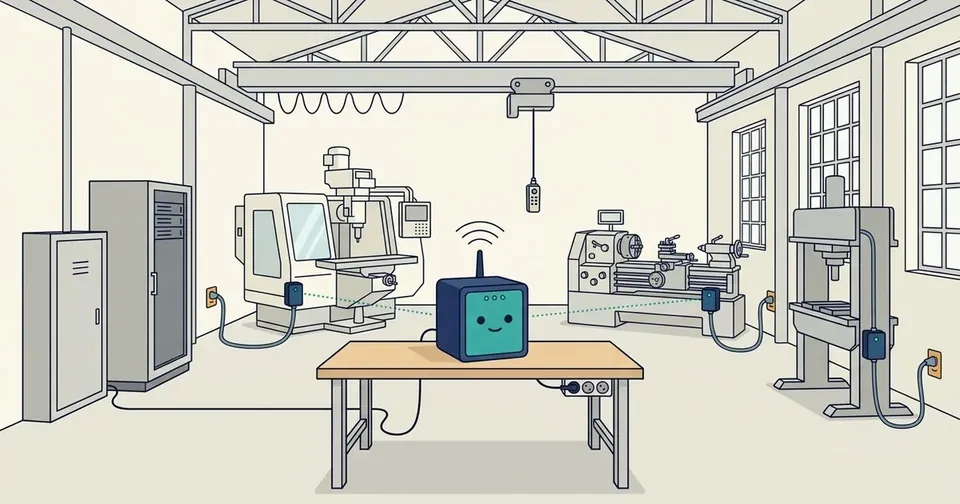
Trust-Buster acts at the physical boundary through satellites dedicated to each interface, designed around a secure element. The Cube never delegates permanent authority: it issues temporary signed capabilities; the satellite verifies and executes, nothing more.
Power cut-off outlet (available): Cuts or restores a machine's mains power supply. This is the hard preventive lever. Hardened profile, separate input, local-first operation, no cloud.
RS-485/232 serial gateway (2026 roadmap): A transparent, galvanically isolated component (bump-in-the-wire) placed on the bus of a legacy PLC. It passes, blocks or filters frames (Modbus RTU first) according to the active capability, and logs its actions. A PLC from 2003 thus acquires a cryptographic identity without any modification.
USB-HID proxy (2026 roadmap): Sits between the keyboard and the workstation. Two independent USB cores (STM32H7) only pass keystrokes through if a valid capability is present. Outside a session, the keyboard is silent. Faithful transparency of the HID descriptor, complemented by filtering against malicious keystroke injection (BadUSB).
In the app
Each satellite appears in the Temps réel (live) tab under the name of the machine it powers, with its power measured second by second. Tapping a satellite shows its curve: at a glance you recognise a press's work cycles, a lathe idling, or a machine that should not have started.
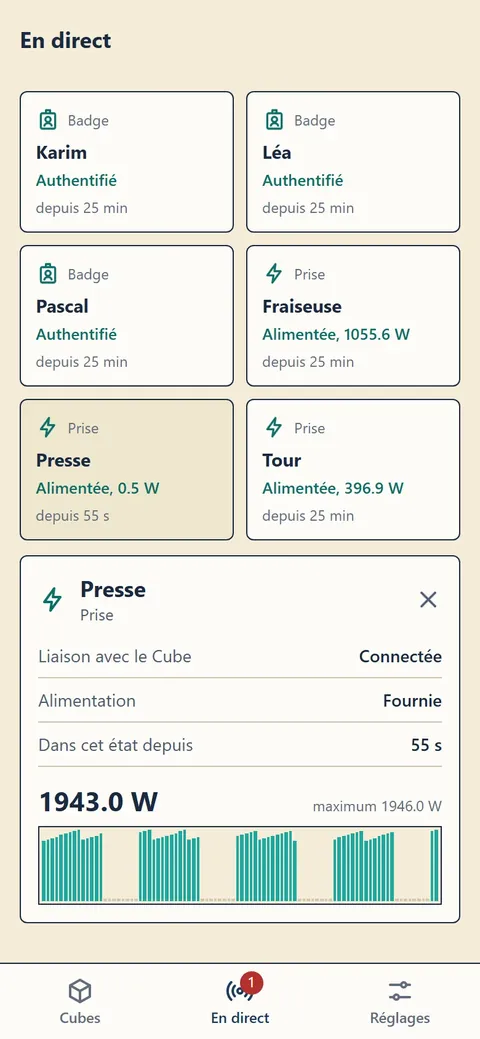
Screenshots taken in demonstration mode with fictitious data; the app interface is currently in French.
The phone has no direct access to the satellites: it only displays what the Cube sends it. If a satellite is unplugged or removed, the Cube notices, the block turns red, and the socket stays locked until an administrator reactivates it.