
OT Retrofit: Addons instead of Upgrades
· 8 min read · Updated
Lire en français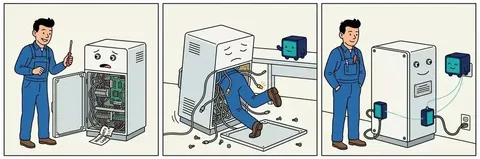
We have run into the question of "securing" an existing industrial machine often enough, which the trade calls OT retrofit, and the first idea that comes to mind is to look for whatever the manufacturer provides for changing a module or reflashing the firmware on its boards.
We ended up making a different choice, because once you add up the effects on cost, compliance and security, it seemed the most reasonable one, and here is the reasoning that took us there.
Why an industrial machine is not managed like a server
Equipment built to last fifteen or more years
Where business IT gets patched, rebooted and replaced every few years, a PLC (programmable logic controller) from the 2000s, an industrial chiller or a hydraulic press was designed to run for over fifteen years, and they were designed at a time when nobody imagined that strong authentication would one day have to be bolted onto them.
No natural foothold for cybersecurity
That does not make this equipment obsolete, because it does exactly what is asked of it, but it offers none of the features modern security mechanisms rely on, and replacing it is usually neither desirable nor affordable. It is precisely from that starting point that, in our view, OT retrofit remains possible and deserves to be revisited using dedicated add-on components.
Modifying the machine: the costs rarely anticipated
The temptation is to bring the machine "up to standard" by working directly on it, but touching the core of an industrial asset triggers a chain of consequences that tend to be underestimated at the moment of a purely financial decision ("this must not cost more than buying a newer machine") or a purely technical one ("if we can pull it off at all, that will do").
Compliance called into question
A machine carries a CE marking and a safety assessment that rest on a specific configuration, and opening the cabinet, rewiring, or inserting a module into the circuit can be enough to put that compliance in doubt, and may even trigger a fresh risk assessment.
Liability shifted onto you
Working on a manufacturer's equipment frequently means taking on part of their warranty, because what used to be their responsibility becomes, the moment the cover comes off, partly yours.
Availability compromised
Any intervention on equipment in production means downtime, scheduling and risk, and on a critical site that is far from trivial.
Maintenance debt
Every modification eventually becomes a special case, one that has to be documented, maintained and understood for the entire service life of the machine, and taken together these constraints mean you often end up inheriting the very problem you set out to solve.
A module inside the cabinet moves the problem, it does not solve it
One variant looks smarter, since rather than reworking the machine, you add an intelligent module to it, but the moment you enter the equipment, you modify it, with exactly the same consequences as above.
In doing so, you also give up two forms of control. Cost, first, because every integration becomes bespoke work that is hard to replicate from one site to the next, and security, second, because you are grafting a component inside a system you never fully know, and in environments this demanding that is a lot of unknowns.
Our choice for OT retrofit: enforcement at the boundary of the machine
So we preferred another route, placing standalone units that sit at the boundary of the equipment, on the power cable, on the radio link, on the serial bus or on the network port, rather than inside it.
The model we follow fits into a single image, an anchor and satellites, because a decision unit, which we call the Cube, acts as the trust anchor for a zone, and effectors, the satellites, enforce the decision, one per interface.
The existing equipment itself is never touched, so its compliance remains intact, its manufacturer stays solely responsible for its core, and the whole arrangement can be removed without leaving a trace.
This is not an absolute rule, and other approaches have their merits, but it is a choice we stand behind, because it preserves what already works.
Keeping custom development to a minimum
This choice would be of limited interest if it forced us to reinvent every building block, so we hold ourselves to a companion rule, which is to keep custom development to a strict minimum, assembling proven modules rather than designing bespoke ones.
The Shelly example: a lot of function in a very small box
The Shelly module is a good illustration of why we prefer to assemble rather than design, because a tiny, inexpensive component already brings together Wi-Fi, Bluetooth Low Energy, dedicated protocols such as Matter, power metering and a switching relay.
The whole thing fits inside a sealed enclosure with two simple cable glands, one in and one out, which is enough to protect equipment outdoors or in a damp environment, and the ratio between price and built-in functionality is, quite honestly, hard to match with in-house development.
From this module, we keep only the behaviour we want, because commands go through our unit, the physical input merely signals, and the relay obeys nothing but the local decision, and we can disable every ancillary feature, in particular the vendor cloud and smartphone app control.
The security layers you can stack on top
This small module is not just versatile, because it already offers several layers of security to build on, and others that can be enabled or added on top, and we summarise them here since they deserve an article of their own.
At the network level, Wi-Fi with WPA2 / WPA3 and MQTT protected by mTLS encrypt and authenticate the exchanges, and Matter brings its own model, with certificate-based device attestation and secure commissioning. The stock firmware updates over a signed channel, which limits the risk of remote tampering, and local access (web interface, RPC calls) can be authenticated, with the physical input decoupled from the relay so that the button signals without ever directly commanding.
On top of all that, we add our own layer, with signed ephemeral capabilities, a decision taken locally, and a default-to-stop behaviour whenever there is doubt.
The point, at this stage, is simply that an off-the-shelf module can carry serious security without heavy custom development, and we will detail these protocols, and how to combine them, in a follow-up article.
Open source building blocks, in software and in hardware
For everything else, we favour open source building blocks, in both software and hardware.
The firmware we develop is released under a free licence and builds on open, audited frameworks such as Espressif's ESP-IDF or the Linux Foundation's Zephyr RTOS. On the hardware side, we build on open platforms, documented microcontroller boards, shared designs, open hardware cellular modules such as Walter, whose schematics and KiCad footprints are published, which let us understand exactly what we are deploying.
The work we keep in-house then concentrates on what actually creates our value, the chain of trust that ties these building blocks together, not the plumbing that makes them run.
The double effect: cost and security
This position has a double effect, and that is why we hold to it, because it controls cost, since an off-the-shelf module has a price known in advance and repeatable from one site to the next, and it also controls security, since a component we have chosen, whose firmware and behaviour we know, can be audited and hardened.
Interfacing with legacy equipment, interface by interface
One pattern, applied to every interface
The other merit of the add-on approach is that it stays largely agnostic to the machine being protected, the same pattern playing out interface by interface: cutting a 230 V supply, filtering a USB keyboard or mouse, proxying a wireless peripheral, segmenting an Ethernet port, or sitting in line on an RS-485 / Modbus serial bus.
In each case, an ageing asset is enrolled without being modified, because you observe it, you surround it, and you act at its boundary.
What works today, what is coming
To be clear, the effector that is fully operational today is power cut-off, and we have explained elsewhere why cutting the power is not an emergency stop, while the other interfaces are on our roadmap and rest on the same principle, with first look going to the customers who come to us with a new edge case.
Concrete building blocks, and where to find them
To make all this tangible, here are a few examples of OT retrofit without touching the machine, and the solutions, commercial or open source, to build on.
Four things you can do without opening anything
- Cutting power to an uncooperative variable-speed drive using a Shelly Pro 1PM clipped onto the DIN rail in the cabinet, without ever opening the drive itself.
- Spotting a stray BLE tracker, or a suspicious 433 MHz remote, with a listening radio gateway.
- Isolating a PLC segment behind a network gateway, without having to reconfigure the PLC.
- Talking read-only to an ageing Modbus PLC to inventory it, without ever writing to it.
The toolbox
- Switching and energy metering: Shelly (off-the-shelf modules, from DIN rail to plug), with ESPHome or Tasmota as free alternative firmware.
- Open source embedded: ESP-IDF and Zephyr RTOS for software, and Walter with its QuickSpot repositories for open cellular hardware.
- Hardware root of trust: STMicroelectronics' STSAFE-A120 secure element, on a Common Criteria EAL5+ certified platform, complemented by the GSMA's IoT SAFE framework.
- BLE and sub-GHz listening: OpenMQTTGateway (BLE and 433 / 868 MHz) and the rtl_433 decoders.
- Network and fieldbus: OpenWrt to segment an Ethernet port, libmodbus to interface with an RS-485 / Modbus bus.
- Satellite design: the free electronics CAD tool KiCad, which we also use to publish our own schematics.
None of these building blocks is a secret, and that is precisely the point, because we save the bespoke work for what really makes the difference, the chain of trust that ties them together.
A successful OT retrofit is a layer, not a graft
Grafting an organ always means risking rejection, whereas adding a layer stays reversible, costable and under control.
We do not claim, in doing this, to make the machine "new", because prolonged physical access remains physical access, and we would rather document that than deny it, as we explain in our article on remote access and physical access.
This approach has the merit of bringing trust back where there was none, without imposing anything on what already works, and to our minds it is the most honest way to carry out an OT retrofit on an installed base you cannot replace.
Want to see the principle in action? In a demonstration, you take the intruder's seat, you try to defeat the system, it responds in front of you, and you leave with the signed audit log of your own attempts.