
Security Principles in OT
· 19 min read · Updated
Lire en français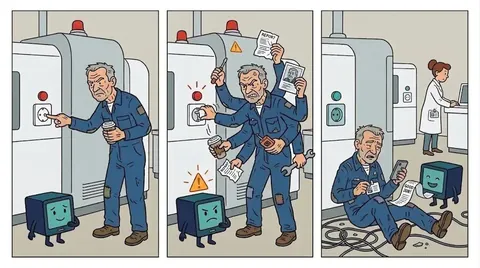
People usually ask us whether "it's encrypted", and the question is a fair one, but it is not enough, because the security principles in OT do not boil down to encryption and there are plenty of ways to defeat an access control system fitted to electrical equipment.
So this article starts with a precise statement of what we do to secure the whole process, describes who the solution is meant to hold against, and then works through the concrete ways someone might start a machine they have no right to start.
A security walkthrough of a workshop access control system
The claim we make
Here is what we sell with the first solution Ops-Devices has developed, in the context of machines to be switched on or off according to who is authorised:
No protected equipment can be energised unless an enrolled badge is present, and only for as long as it stays present, with the system checking that its holder is acting within the time slot granted to them, on the machines they are authorised for, and that the switching device is intact and reachable. Every attempt, successful or not, must leave a trace timestamped to workshop time.
The setup
Four machines in one room, with no modification whatsoever to the protected equipment, a radio badge carried by the person intervening, a standalone decision unit within range of the zone, a head-end module in the cabinet that feeds and meters each channel, four controlled outlets on the machines' power supply, and the supervisor's mobile app, which shuttles between the machine room and the offices (keeping a daily link with the administration server, for instance).
The unit has no network access at all and every decision is taken locally, which has a direct consequence for the demonstration, because cutting the internet changes absolutely nothing in how the system behaves, but the flip side is that alerts stay confined to the plant room. The access rules therefore have to be right, and sometimes strict, since no remote confirmation from a supervisor is available.
The threat model, or the adversary we designed against
We are placing ourselves against someone who has legitimate or tolerated physical access to the zone, a subcontractor, a temp, a service provider, a visitor left alone, who has ordinary tools and a few minutes, and whose motivation is convenience, that is to get a machine running and move on, working around a procedure they find cumbersome, to save time.
We are not placing ourselves against an adversary who would set up a radio relay, analyse an advertisement and clone it, or swap a module for a hardware clone. Those threats are real, they belong to a different budget and a different system, one we have designed, and they are the subject of other articles, including the one on jamming, relays and the Flipper Zero.
The foundation of our security principles in OT: three boundaries and one fallback position
The claim above rests on three distinct boundaries, none of which can do the work of the other two, and on a default behaviour that makes every failure harmless.
| Boundary | The question it answers |
|---|---|
| Human → decision | Who is here, and do they have the right, now? |
| Decision → enforcement | Does this order come from the authority, and is it valid? |
| Enforcement → machine | What can this device do, and what must it never do? |
There is a familiar parallel here with the keyed inserts on UPS outlets, because every sysadmin has chased colleagues who plug a coffee machine or a bike battery into the red sockets, since "we've got our own priorities anyway". So we replace the plastic keying with equipment that cannot be prised open with a biro barrel, and more to the point we avoid the production halted, the machining or 3D printing hours lost, and the servers shut down mid-experiment.
The fallback position is denial. Outlets stay off until a positive decision has been taken, not the other way round, which is fail-secure behaviour, so a unit failure, a lost link, an unreadable badge, a missing schedule or a jammed radio all return to the same de-energised state.
That choice carries a real operating cost, since the system has to work for production to run, and we accept it, because an access control that fails open is not a degraded control, it is an absence of control with a green light on. Security here is physical (unplug a cable, swap two devices, spoof the sensors) before it is ever a matter of protocols.
The demonstration, attack by attack
Each attack below is described with what stands in the way, why it holds and what remains open, because that is how we prefer to present security principles in OT, by what they concretely prevent rather than by the list of algorithms involved.
1. Walk up to the machine and press the button
The attack. The most common by far, because nobody hacks anything, you stand in front of a connected outlet and press the switch. We had assumed everything would be driven remotely, but even on budget hardware there is always a physical alternative.
What stands in the way. On the outlets we recommend, the physical button is decoupled from the relay by configuration, so pressing it no longer commands the output and only the decision layer can energise. Simple, but necessary, and it justifies spending €30 instead of €10.
Why it holds. Because the link between button and relay no longer exists in the outlet's firmware, which we have kept control of, rather than merely being refused after the fact by a software rule. There is nothing to bypass since the function is gone, and without this setting everything else would be decorative, because anyone standing in front of the outlet would take back control of the equipment.
What remains. A factory reset of the module would restore its original behaviour, but that takes prolonged physical access and announces itself, because the module reappears under its default identity and stops answering the unit, which triggers the mechanism described in point 2, a second line of defence in other words.
2. Unplug the outlet and plug the machine in elsewhere
The attack. The common-sense workaround, and the one we most often see overlooked in competing systems, because if the outlet refuses, you remove it, and the answer is not more glue.
What stands in the way. Each outlet is fed by a channel of the head-end module in the electrical cabinet, and if the unit loses the link to an outlet for several consecutive cycles, it cuts the channel feeding it and records the event in the log as critical, but only after trying to find it again, so that ordinary radio interference does not trigger a reaction. We selected components that are reliable but affordable, the aim being to scale up and equip every outlet.
Why it holds. Because the cut happens upstream of the device that was removed, at a point the attacker is not holding while they manipulate the outlet, so the simplest workaround costs them a power cut and leaves a trace.
What remains. The protection only covers what the head-end module feeds, so plugging the machine into a wall socket outside the perimeter falls outside the system entirely, and is a matter for the electrical installation rather than for access control.
3. Replay a captured order
The attack. Record the radio exchanges while a legitimate holder obtains access, then replay them later for the same effect, which is the classic replay attack against any system that merely encrypts. Two years ago it was a heavy workaround requiring real knowledge, but since the spread of the Flipper Zero and similar devices, the move is within reach of an amateur with no particular training.
What stands in the way. When the app connects to the unit, the unit draws a thirty-two byte nonce (an unpredictable, single-use number) and expects in return an attestation signed by the authority, together with that nonce signed by the device's key, and the nonce is consumed no matter what, whether the attempt succeeds or fails. This is our own contribution, because it did not exist in the off-the-shelf equipment.
Three further checks cover rights updates, since an update addressed to a different unit is refused, an update whose sequence number is not higher than the last one applied is ignored, and the list of authorised holders is replaced wholesale, never merged.
Why it holds. Because replay does not merely become ineffective, it becomes impossible to repeat and it is detectable, since every attempt burns the current nonce and every stale packet meets a sequence number that does not go backwards. Without wholesale replacement, an attacker could replay an old packet to resurrect a revoked holder, and that is precisely the flaw this innocuous-looking detail closes.
The refusal also comes with a reason, because the unit answers by naming it, no nonce, unrecognised authority, invalid proof of possession, expired attestation or holder not on the list, so that a rejection is distinguishable from a fault, both in the log and on the supervisor's screen. We have also worked out a colour code that lets you walk into a room and see at a glance what is cut, what is live, and what has been tampered with.
4. Impersonate the authority
The attack. Forge a rights update to add yourself to the list of authorised holders, or to widen a time slot.
What stands in the way. The unit verifies the authority's signature using a public key embedded in its firmware, which the sender of the message can neither supply nor replace, and verification is performed on the bytes exactly as received, before any interpretation.
Why it holds. The order of operations is not a detail, because verifying the received bytes and then parsing them, rather than the reverse, eliminates a whole class of flaws in which the message as written differs by a byte from what was signed, and tampering with the content breaks the signature as long as the authority's private key stays secret, which brings us back to point 12.
As for anchoring the key in firmware, it means a software update is required to change it, and that is a drawback we much prefer to the risk of an attacker replacing the authority itself. Over-the-air update mechanisms, with no need to open the Cube, our on-site decision unit (overview), or its satellites, are now widely available on a great many components, and we always select parts to which standard IT security practice applies, so that we can concentrate on the security principles in OT that have no equivalent on that side.
What remains. This anchoring is only worth something if the component cannot be reprogrammed, so hardware secure boot and encryption of program memory are the logical next step.
5. Make it look as though verification is working
The attack. This one is not carried out by an adversary, and that is what makes it formidable, because a broken cryptographic check is silent. Either it refuses everything, which is noticed immediately, or, far worse, it accepts everything, and no functional test of the product can tell a valid signature from a broken checking routine that always answers yes.
What stands in the way. At every start-up, the unit runs a self-test against published reference vectors, checking that it accepts an authentic signature and rejects a forged signature and an altered message alike, and data decoding and expiry-date parsing are tested the same way, edge cases included.
Why it holds. Because the test fails safe, since if the self-test does not pass, the unit refuses to open its administration channel rather than serving it without checks, so a device whose cryptography is broken does not merely report the fact, it stops accepting orders.
6. Wind the clock back to open a time slot
The attack. The schedule authorises a holder from seven in the morning to ten at night, it is eleven, and all you need is to convince the unit that it is three in the afternoon.
What stands in the way. Setting the time is treated as a mutating operation, on the same footing as a rights update, so it requires an authenticated session, and without one the request is refused with its reason.
Why it holds. Because the clock is not a technical convenience but a security parameter, since it governs time slots, attestation expiry and log timestamping, and leaving it freely modifiable would have offered a way around everything else, and made it possible to date anything at will. In the OT world this is a perennial problem, because there is no counting the systems running twelve hours out, still on winter time in mid-summer, or unaware of public holidays, and it is often one of the first reasons a system gets abandoned, particularly in BMS and HVAC.
What remains. One edge case is worth knowing about, because at the very first start-up, before a trusted time has been supplied, attestation expiry cannot be evaluated, and the unit lets that specific check through, the authority's signature still being required, and the exception is written to the log. It is a deliberate trade-off, visible at audit, and tightening it is on the register, subject to your future requirements.
7. Delete an inconvenient line from the log
The attack. Tamper with the system, obtain access (or not, that is what we are claiming), then make the trace disappear, or, more subtly, use the shuttle to lose a report along the way, because a mobile app collects the local logs and carries them to an area with network coverage, so cutting off the app cuts off the administration server's view.
What stands in the way. Purging the log requires an authenticated session, and the unit refuses to acknowledge entries that do not yet exist, and each session also carries an identifier drawn at start-up, which lets the app detect that an acknowledgement comes from an earlier session and decline to relay it.
More fundamentally, nothing counts as transmitted until the recipient has confirmed it, because an entry is only purged from the unit once the authority has recorded it, and the transfer log shown to the operator adds a line only after the recipient's acknowledgement, never after the send.
Why it holds, partially. These mechanisms prevent accidental loss and cross-session mismatch, which are the real causes of misleading logs, but they do not prove that no entry was removed along the way, and we have devoted an article to what a proof log proves and what it does not.
8. Copy the badge's advertisement
The attack. Listen to a badge's advertisement, reproduce it, and be detected as its holder, or simply hand your badge to a colleague, because "it's easier, and what matters is getting the job done, right?"
What stands in the way, at badge level. Nothing, because the advertisement travels in the clear, it is identical every time, and anyone listening can reproduce it. So we never present the badge as an authentication factor, since it answers the question "is a holder claiming this identifier nearby?", and no other.
What stands in the way after that. The badge is not the barrier, it is the trigger, and still standing in the way are the impersonated holder's schedule, the persistence of presence (access is cut as soon as the advertisement disappears), the integrity of the switching device, and the log, which will record the access under the legitimate holder's name, at an hour when that person can say where they were.
Why this is acceptable here. Because an adversary who analyses an advertisement format in order to reproduce it has left the opportunist profile behind, and the measure of risk is not "is it feasible?", since it is, but "does it match someone who actually turns up in this workshop?". That is a judgement, it is revisable, and it changes in the contexts covered by another article on the most sensitive cases.
What remains. The weakest point of the assembly, identified as such, can be addressed without changing hardware, by using an advertisement payload that varies with each transmission, and for those who want it there are excellent badges we could integrate. One can also pair the badge with a secure ID card presented to the Cube over NFC, though that runs into the lending problem again, in which case you may as well use the mobile app confirmation we have already integrated alongside the trigger badge.
9. Relay a legitimate holder's presence
The attack. Retransmit the conversation between a holder who has stayed in the locker room and the target machine, manufacturing a perfectly authentic presence, because here the badge is not stolen, a bridge is built between the two, and this is our friend the Flipper Zero again, which opened the Pandora's box of cyber-physical system security.
What stands in the way. Nothing cryptographic, and it needs saying plainly, because no signature sees this kind of attack since no message is forged. What is forged is proximity, and proximity is not a property you can sign.
What does raise the cost is that presence has to be maintained throughout the period of use, that the holder's time slot has to be open at the same moment, and that the access is logged under their name.
What remains. A real, structural vulnerability, and one that only time-of-flight distance measurement closes. We do not claim to cover it in our current solution, but we can walk you through UWB-based approaches (ultra-wideband radio, which measures a distance from the signal's time of flight) for a v2, if you bring us the requirement and the budget that goes with it.
10. Steal an operator's phone
The attack. Take the device carrying the attestation and use it to push false settings or purge a log.
What stands in the way. The app requires biometric validation before sensitive operations, and always in emergency mode, the device attestation has a limited lifetime, and revoking a device takes effect as soon as the first rights update is applied, the holder in session being logically disconnected there and then.
Why it holds. Because the phone decides nothing, since it carries objects signed by the authority and verified by the unit, so stealing it grants the right to carry, not the right to issue.
What remains. Revocation only propagates the next time an authorised device passes by, because that is the price of running without a network. And the device key, while it sits in protected storage, is not yet generated inside a hardware enclave, so it is protected from the rest of the device without being non-extractable, and at that point we are back in ordinary IT security territory.
Break-glass, a sealed and traced way out. A designated supervisor can force access in an emergency through an offline procedure, with a single-use code, printed and sealed in a tamper-evident envelope kept in each zone, scanned and then validated by biometrics on their phone. The code is consumed on use, so an opened envelope is an envelope to replace, and the access is granted immediately, timestamped, signed and reported at the next upload, with an explicit obligation to recommission the system. We never place this code permanently on or inside a piece of equipment, because that would make the bypass permanently available to the very person the system is installed against.
11. Cut power to the unit, or jam the radio
The attack. Rather than trying to obtain access, bring the system down and hope it opens.
What stands in the way. The fallback position, because a Cube with no power commands nothing and the outlets stay in the refusing state, and a jammed radio makes presence disappear, which cuts. There is no path, in what we have designed and tested, by which degradation opens an access that was not intended.
Why it holds. Because the direction of failure was chosen at design time rather than suffered, and among the security principles in OT we apply, it is the one we verify first.
What remains. The flip side, which has to be stated to the operator, is that this system is deniable of service, because someone who wants to stop production rather than gain access will manage it by jamming the band, and the answer to that is not technical but organisational, with a derogation procedure, an emergency mode and monitoring of radio availability. At that point we are no longer in the security of the system itself but up against a pair of bolt cutters, which is resolved by building access control and sound HR management.
12. Attack the administration server
The attack. Do not fight the field at all, but go for the key that signs the rights distributed across an entire estate.
What stands in the way. Every signed object carries the identifier of the key that signed it, which makes rotation possible without reprovisioning every device, and the server refuses to sign if its key is absent, rather than improvising a volatile key that would silently invalidate everything already distributed.
What remains. This is today the most sensitive point in the chain, and it would be dishonest to present it otherwise, because compromising this key means compromising the entire estate. Keeping it offline, in a dedicated hardware module, with a documented ceremony, is the measure that closes the risk, but here again this is IT security, addressed by proven means.
What each mechanism proves, and what it does not
This is the table we consider most useful to keep in view, because a solid system, by the security principles in OT we hold to, is not the one that stacks up the most mechanisms, but the one in which every mechanism is used for what it actually proves.
| Mechanism | What it proves | What it does not prove |
|---|---|---|
| Badge advertisement | That a transmitter carrying this identifier is nearby | Identity, because the payload is copyable |
| Signal strength filter and hold window | A plausible, sustained radio proximity | A real distance, because the signal can be relayed |
| Single-use nonce | That the exchange is fresh and not replayed | That the other party is physically present |
| Authority signature | The origin and integrity of distributed rights | That the authority key is well guarded |
| Increasing sequence and bound recipient | That a stale or diverted order does not apply | No particular reservation |
| Start-up self-test | That verification actually works | That the firmware has not been replaced |
| Decoupled button | That the local gesture no longer commands the relay | That a factory reset is impossible |
| Device monitoring | That a removal is detected and traced | That the machine is not replugged outside the perimeter |
| Log carried by shuttle | What the system decided, and when | That no entry was removed along the way |
| Fallback position at denial | That no failure opens an access | That the system stays available |
How to verify this rather than take our word for it
The declared-encryption problem
In this field there is a gap between what datasheets announce and what equipment does, and that gap is not always bad faith, because a cryptographic suite can be declared in a data format without being used on the channel, a pairing mode can be supported without being required, and a value can be readable without authentication while the product is sold as encrypted.
We chose to treat this as a testing problem rather than a communication one, that is to state the properties the link ought to hold, measure them one by one, and make the ones that fail do so loudly, because security principles in OT that are not measured remain intentions. That test bench is what produced the register above, not the other way round, and our commissioning support therefore aims to reproduce these measurements on your own installation before it goes live.
Why this is enough in the vast majority of workshops
Take the twelve attacks again. Seven are closed by construction, the button, the replayed order, the impersonated authority, the broken verification, the wound-back clock, the stolen phone and the induced failure, one is detected and traced pending being blocked, the removed outlet, and four remain open in whole or in part.
And those four (copying an advertisement after analysing it, setting up a relay, losing a log entry along the way, reaching the administration server's key) have one thing in common, because they all require leaving the opportunist profile behind, since they assume hardware, time, intent, and most often a return to the scene.
This is where our judgement distinguishes two solutions, and we present them to you as such. In a workshop, a machine room or a warehouse where the realistic threat is a shortcut taken by people who are legitimate but not authorised, it is enough that every shortcut costs more than the normal procedure, and that is the case our solution is built for. On a site where someone is willing to pay the financial and technical price of getting in, that reasoning no longer holds, and a different system is needed, with hardware, procedural and software measures matched to the potential harm.
The rest is a question of proportion, with four off-the-shelf modules, no intervention on the equipment, no requalification of the process, no network dependency, and a twelve-line register you can put on the table, and that is the concrete form the security principles in OT take, for us, in a workshop. That is what we can already put in place for you today.