
Detecting Presence Without Monitoring Employees
· 5 min read · Updated
Lire en français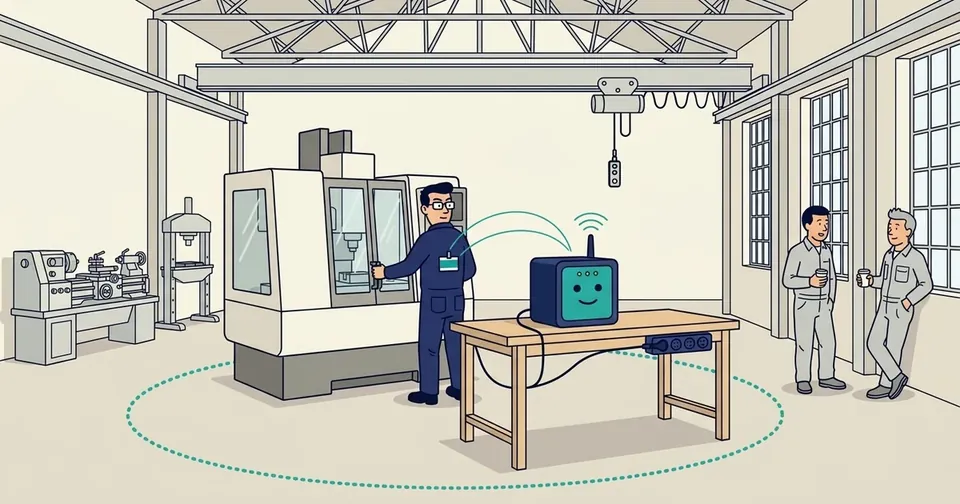
Machine access control rests, by construction, on sensitive information, since it works by detecting presence, that of an identified person at a given place and time, and that is what makes it useful, but it is also what brings it close, if one is not careful, to an employee monitoring tool, because the technology is the same in both cases and the difference lies in the purpose, the rules of use and a few design choices best made before installation rather than after the first works council meeting.
This article is for operators, HR directors, data protection officers and staff representatives reviewing a machine access control project.
What the device actually collects
It is worth starting with a precise description of what is recorded, because concerns often stem from a broader idea than reality. The work of a Cube, our on-site decision unit (overview), consists in detecting presence, since it establishes that an enrolled token, badge or phone, is near a machine, verifies its identity through a cryptographic exchange, and records the decisions it takes, grant, denial, alert, bypass attempt, but it does not film, records no sound, does not locate anyone outside its perimeter and uses no biometric data.
What it produces is nonetheless personal data as soon as it is tied to a named person, and when presence is crossed with machine use to infer what someone did and for how long, one enters the field of monitoring employees' activity, which has its own rules.
What the law requires
Taking France as an example, three bodies of rules overlap, as we understand them without being lawyers, and none of the three seems to us something one can leave aside, while other EU countries have, as far as we know, comparable rules, often stricter regarding works councils.
Labour law. No information concerning an employee personally may be collected by a device not previously brought to their attention (Article L1222-4 of the French Labour Code), restrictions on employees' freedoms must be justified by the nature of the task and proportionate to the aim pursued (Article L1121-1), and the works council (CSE) must be informed and consulted, before they are implemented, on the means and techniques allowing employees' activity to be monitored (Article L2312-38). The word before matters, because on our reading a device installed prior to that consultation is hard to regularise afterwards, and what it collected may not be usable against employees.
The GDPR. Processing must pursue a specified and legitimate purpose, collect only necessary data, keep it for a limited period and inform the people concerned, and for badge access control to premises the French data protection authority (CNIL) states that access data should be deleted three months after it is recorded, which gives a useful order of magnitude, even though a specific evidential purpose may justify a different period, provided it is documented.
The impact assessment. The CNIL lists among processing operations requiring a data protection impact assessment, the DPIA, those whose purpose is to constantly monitor employees' activity, and a well-designed access control does not have that purpose, but it is prudent to demonstrate it in writing rather than assume it, and the impact assessment is often the best document for doing so.
A question of purpose
Everything hinges on purpose, and that is what must be stated clearly before the works council, because some purposes are in our view legitimate and proportionate, such as ensuring a dangerous machine is only used by trained people, detecting use outside a slot, keeping track of the external contractors who come to your machines or billing the use of shared equipment, while others are not, and we refuse them on principle, such as ranking individual productivity, measuring break times or tracking a person's movements through the building.
A charter forbidding these uses seems to us less protective than a device that does not make them easy to carry out, and that is therefore what we sought to achieve in design rather than in usage policy.
Detecting presence without reconstructing activity
Aggregate by default. Reports are produced per machine, per period and per organisation, and named attribution only appears on a trigger defined in advance, use outside a slot, anomaly, bypass attempt or justified audit request.
Distinct retention periods. Named data has a short retention period, set with you, whereas machine consumption data, which no longer has anything personal once detached from presence, follows your management needs.
No tracking outside the perimeter. A Cube knows nothing of what happens beyond its range and does not try to reconstruct a route, because it answers a narrow question, which is whether this person, authorised or not, is here, in front of this machine.
Data stays on site by default. Decisions are taken and data is processed locally, in the Cube, and nothing leaves for a server unless you have decided so, which greatly simplifies the record of processing and the question of transfers.
The device announces itself. Signage near protected equipment and individual information at enrolment are part of the deployment, just like installing the sockets.
An order for doing things
If you are considering such a device, we would suggest proceeding in this order, which avoids most of the difficulties we have seen in the field.
- Write down the purpose in one sentence, with the list of excluded uses.
- Involve the data protection officer, the DPO, from the start, and carry out the impact assessment if it is required or if there is any doubt.
- Inform and consult the works council before any installation, describing what is collected, what is not and the retention periods.
- Start in Observation mode, which cuts nothing and lets you show the works council, with data, what detecting presence means in practice and what the device actually sees.
- Inform each enrolled person individually, employee or external contractor.
A project presented this way has been well received in the cases we have encountered, because it answers a concern teams share, which is knowing that the dangerous machine next door cannot be started by just anyone, and it is an occupational safety argument before it is a control argument, so we believe it should be presented as such.
For what the Cube knows, and will never know, about the use of the machines themselves, see What the Cube Knows About Your Machines, and for radio monitoring specifically, see Is Radio Monitoring in a Workplace Legal?.
Sources
- French Labour Code, Articles L1121-1, L1222-4 and L2312-38.
- Regulation (EU) 2016/679 (GDPR), Articles 5, 6, 13 and 35. EUR-Lex
- CNIL, Exemple d'information en cas d'accès à des locaux professionnels par badge. cnil.fr
- CNIL, Liste des types d'opérations de traitement pour lesquelles une analyse d'impact est requise (deliberation No 2018-327 of 11 October 2018). cnil.fr