
USB and Serial Links: The Door Left Open
· 5 min read · Updated
Lire en français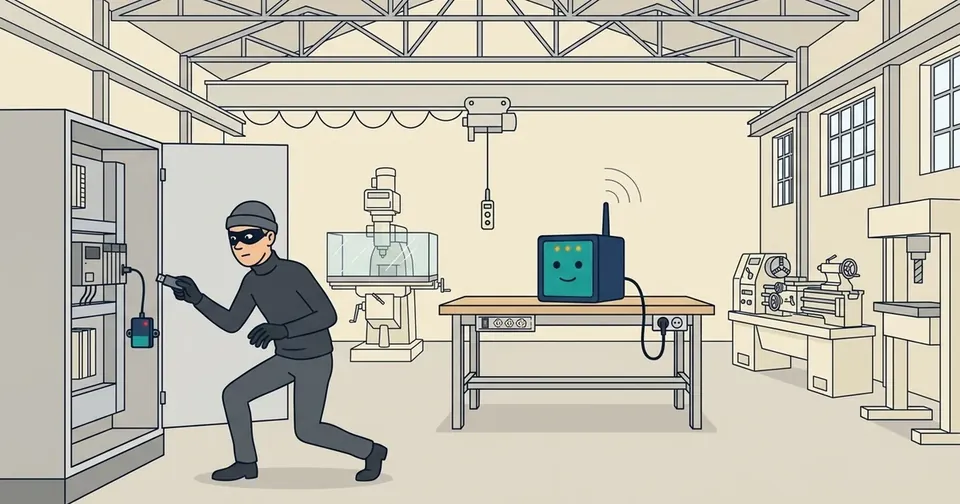
It is commonly said that equipment not connected to the network is protected from cyberattacks, and that is partly true, since it is a decision many operators take knowingly, but it forgets that this equipment almost always has another door, more discreet and often open to all, which lives in the USB and serial links of the machine, because there is a USB port on the front of the operator panel, a serial or Ethernet programming port on the controller, and a maintenance connector in the cabinet. Updates, backups and settings go through it, and so can everything else.
This article is for industrial systems security managers and maintenance teams running a fleet of equipment isolated from the network.
An interface that trusts whatever is plugged in
The USB port was designed for convenience, because a device receiving a peripheral asks it what it is and takes its word for it, whether it presents itself as a storage stick, a keyboard, a network card or a serial adapter, and nothing in the protocol lets it check that the object is what it claims to be.
In 2014, researchers showed that the microcontroller of an ordinary USB stick could be reprogrammed so that, in addition to storage, it presents itself as a keyboard able to type commands far faster than a human hand, and this family of attacks, known since as BadUSB, has given rise to freely sold tools, keystroke-injection sticks, charging cables that hide a radio transmitter, innocent-looking adapters, which require no particular skill and which, on equipment without a log, leave no trace.
Four years earlier, the Stuxnet worm had already shown, on another scale, that an installation isolated from the network, what is also called an air gap, could be reached through removable media and the engineering workstations that read them, so network isolation greatly reduces the attack surface but it does not remove it, because it shifts it to whatever gets plugged in.
The serial port, older and even more permissive
On many controllers, the small industrial computers that drive the machine, and on much older equipment, the programming port asks for no password, or a default password known to the whole trade, and whoever connects to it with the right software can read and modify the program, change control parameters or force outputs. This is not a design flaw by the standards of the time, because the port was in the cabinet, the cabinet was locked, and the person opening it was the automation engineer.
It is exactly that assumption that no longer holds, or not always, because the cabinet opens with a key bought online, the automation engineer is often a contractor, and the laptop they plug in spent the previous day on other sites.
What the frameworks recommend, from ANSSI to IEC 62443
Recommendations converge, and they are not new.
ANSSI, the French national cybersecurity agency, in its detailed measures for industrial control system security, recommends controlling the use of removable media, disabling unused ports, dedicating maintenance workstations to industrial systems and passing media through a decontamination station before any use.
IEC 62443-3-3 devotes a specific requirement to use control for portable and mobile devices, referenced SR 2.3, and another to malicious code protection, referenced SR 3.2, notably asking to restrict the use of removable media and to log their use.
These recommendations are sound, and we endorse them, but their difficulty lies in applying them to the existing base, because disabling a port often means changing the equipment's configuration, which the manufacturer does not always allow, and a decontamination station only protects against media people have the discipline to pass through it.
Interposing on USB and serial links
For interfaces as for power, we preferred an approach that does not touch the equipment and that consists in interposing on the link, at its boundary, because a box placed between the port and whatever is plugged into it can, without modifying the machine, apply a few simple rules.
- Only allow the link on the decision of the Cube, our on-site decision unit (overview), that is for the right person, on the right equipment, during the planned slot, as for powering up.
- Restrict what can present itself on a USB port, for instance refusing a keyboard where only a storage stick is expected.
- Log every connection, including refused ones, with the identity of the person present at that moment.
Such a box does not read the content of files and therefore does not replace the decontamination station, because it only decides who plugs in, when, and in what form, and that is already what is most often missing. We must also be honest about the state of our work, because the effector that is fully operational today, that is the box which applies the Cube's decision, is the one acting on the power supply, while the satellites for USB and serial links are under development and not yet offered as products, and we would rather say so clearly than suggest otherwise.
What can be done right now
Meanwhile, and whatever device is chosen, a few simple measures reduce the risk on an offline fleet.
- Inventory the physical interfaces of each critical piece of equipment, USB and serial links included, noting which ports exist, who can reach them and what they are used for.
- Physically close what is not used, with lockable port blockers and cabinets locked with a lock whose keys are tracked rather than a universal triangle key.
- Dedicate maintenance equipment, that is a laptop and media reserved for industrial systems, used for nothing else.
- Pass media through a decontamination station before any connection, and keep a record.
- Track who opens the cabinet, which is often a simple and yet neglected measure, and that is where access control at the equipment boundary joins the topic.
For the particular case of the contractor who comes to plug a laptop into the controller's port, see also External Contractors: Who Touches Your Machines?.
Sources
- Nohl, K. and Lell, J. BadUSB: On accessories that turn evil. Black Hat USA, 2014. infocondb.org
- Falliere, N., Murchu, L. O. and Chien, E. W32.Stuxnet Dossier. Symantec, version 1.4, February 2011.
- ANSSI, La cybersécurité des systèmes industriels, mesures détaillées, 2014. cyber.gouv.fr
- IEC 62443-3-3:2013, System security requirements and security levels (SR 2.3, SR 3.2).