
Shared Workshops: Who Answers for the Machine?
· 10 min read · Updated
Lire en français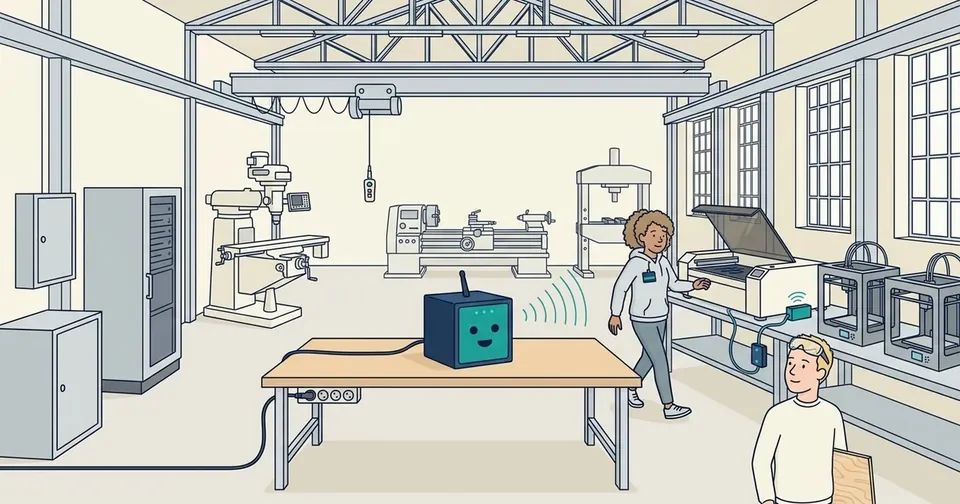
The Cube, our on-site decision unit (overview), was not born in a factory, nor in a defence programme, but in one of those shared workshops where dangerous machines are available to dozens of people, and more precisely in a question we asked ourselves when we became responsible for one of them, because someone has to know who answers for what happens there, and how anyone knows.
This article is for managers of fab labs, makerspaces, school and university workshops, laboratories and shared technical platforms, for the chairs of the associations running them, and for their insurers.
SoFAB, the Sophia Antipolis fab lab
In October 2014, the Telecom Valley association opened SoFAB, the Sophia Antipolis fab lab, in the premises of Polytech Nice Sophia on the SophiaTech campus, together with the University of Nice Sophia Antipolis, the Pobot robotics association and a dozen partners from the local ecosystem. The project had matured for two years and it was led by Pascal Flamand, then vice-president of Telecom Valley in charge of the fab lab, and the place brought together 3D printers, a CNC milling machine, a laser cutter, a vinyl cutter and professional workbenches, and it was deliberately open to all, students, secondary school pupils, project leaders, employees of small firms and large groups, the general public, with time slots for each audience.
On 31 March 2015, Pascal Flamand became president of Telecom Valley, and with the role came a responsibility that is hard to gauge until one takes it on, that of the association making machine tools available to an open public, and that of its president, because the laser cutter can catch fire, the milling machine can injure, and a teenager who came to discover 3D printing can walk past a machine they never learned to use. As in any fab lab, rules, training and supervision by the fab manager and volunteers exist, but at the moment a machine starts, nothing tells whether the person using it has been trained, whether it is their slot, or even who they are.
An answer was needed that relied neither on locking the machines away, nor on a supervisor's permanent presence, nor on trust alone, and that search gave birth to the Cube, devised by Julien Holtzer, a volunteer at the fab lab, together with Pascal Flamand, and it is the same question, transposed to industry, that we address today.
A place where liability dissolves
A shared workshop brings together conditions rarely found together in industry, because users are many and change often, their skills range from yesterday's beginner to the seasoned professional, opening hours are wide, sometimes without supervision, and the machines were not designed to know who is using them, and to this one readily adds a culture of trust and mutual help, which is the charm of these places and makes setting rules all the more delicate.
In this context liability does not disappear but it dissolves, because it is shared between the association running the place, its president, the institution hosting it where applicable, the supervisors, the trainers and each user, and the day an accident happens it must nonetheless be reconstructed, and that is when one discovers what one should have been able to show.
What other shared workshops have been through
Serious accidents remain rare in shared workshops, but those that are documented look strikingly alike, and they are all about access as much as machines.
Vienna, spring 2011. At Happylab, one of Europe's first fab labs, a member starts a job on a new laser cutter and goes to lunch, then the machine's axis gets stuck, the laser heats the same spot for a long time, the acrylic catches fire, then the lid and the ceiling, and six fire engines are called, the machine is destroyed and much of the space is burned or covered in soot, but nobody is hurt. Rather than restricting opening hours, the founders design a box that controls the machines' power and requires the user to authenticate regularly, or the machine stops, and that device later became a product in its own right, so we are not the first to conclude that the power supply is the right place to enforce a rule of use, and we find it rather reassuring that others got there by another route.
New Haven, April 2011. A Yale University student dies after her hair is caught in a lathe in a laboratory's machine shop, where she was working alone late in the evening, and in its findings the US Occupational Safety and Health Administration notes that the lathe lacked an emergency stop button able to cut power, that the rules for using the equipment were not posted, and recommends that students do not work alone, after which the university immediately launches a review of the rules of all its workshops with power equipment.
In industry too. The ARIA database, which records technological accidents in France, mentions for instance a fire that broke out in 2017 on a laser cutting machine in a plastics plant in the Meuse, where the fire spread to the 800 m² building, two employees were hospitalised for smoke inhalation and production stopped for two days.
These three cases differ in severity, but they raise the same question as ours, because one has to know who was in front of the machine, whether they were trained, whether they were alone, and whether the machine could run without anyone watching.
Liability, including the president's
We are not lawyers and this article is no substitute for advice, but a few general principles of French law, as we understand them, shed light on the question, and most European countries follow, as far as we know, comparable rules.
Custody of the thing. In civil matters, one is liable for damage caused by things in one's custody (Article 1242 of the French Civil Code), and in a shared workshop the question of who had custody of the machine at the time of the accident, the association or the user, is often the first one debated, and it depends largely on what governed its use.
The duty of safety. Whoever provides a service must do so in conditions offering the safety one may legitimately expect (Article L421-3 of the French Consumer Code), and when the workshop employs staff, such as a fab manager, the French Labour Code also places a safety obligation on the employer (Article L4121-1), which involves assessing risks (Article L4121-3), providing suitable work equipment (Article R4321-1) and training those who use it.
The president, the association's agent. The president of an association acts on its behalf, and in civil matters it is in principle the association, as a legal person, that compensates damage caused in the course of its activities, whereas the president only answers personally to the association for management faults (Article 1992 of the Civil Code, applied less strictly to an unpaid mandate), and towards third parties only for a fault separable from their duties, meaning one of particular gravity and incompatible with their normal exercise, of which failing to take out mandatory insurance is the classic example.
The president before a criminal court. This is where the question seems to us most serious, because the criminal liability of the association does not exclude that of individuals (Article 121-2 of the French Criminal Code), and in case of injury or death a president who did not directly cause the harm but created the situation that allowed it, or failed to take the measures to prevent it, may be held liable if they committed a characterised fault, exposing others to a particularly serious risk they could not ignore (Article 121-3, as amended by the law of 10 July 2000). Leaving a dangerous machine accessible to all, without control and knowing the risk, seems to us to come close to that definition, even though it is for the court to decide in each case, and a delegation of powers to a fab manager can shift this liability, provided the delegate genuinely has the competence, authority and means required.
In all these cases, what makes the difference has less to do, in our view, with the existence of rules than with the ability to show that they were applied, because a signed charter and a training session weigh little if, in practice, anyone could start the machine, and house rules declaring the association "not liable" for accidents carry limited weight against a safety failure.
The usual answers, and their limits
Shared workshops have not stood still, and one usually finds a stack of reasonable measures.
- Mandatory training, sealed by a "machine passport" or internal qualification, is essential, but nothing stops an untrained person from pressing the button.
- Online booking of time slots organises use but does not control it, since the machine knows nothing of the schedule.
- Key or badge boxes on some machines work, but they are costly to generalise, often vendor-specific, and they usually do not know whether training is up to date.
- The presence of a supervisor remains the best protection, but no place can guarantee it at every hour.
Each of these measures addresses part of the problem, but none links the three pieces of information that matter when the machine starts, because one has to know who is there, whether they have been trained on this machine, and whether it is their slot.
What the Cube does in shared workshops
That link is exactly what the Cube was designed to establish, and it is in this context that the logic of machine access control appears most simply, because each machine is powered through a controlled socket, and for it to receive power the Cube must establish the presence of an enrolled person, check that their training on that machine is valid, and that the use matches an authorised slot, so all three conditions are needed at once, failing which the socket stays off.
Two behaviours matter particularly in an open place, and the accidents above show why. When the authorised user walks away while the machine is still powered, an alert is raised and the machine can be protected against being restarted by someone else, and for a laser cutter left alone a rule can go as far as requiring the user's presence throughout the job, while when a rule requires two people for a machine, or forbids its use outside supervised hours, the Cube can check it rather than rely on a notice on the wall.
The log, finally, answers the question one always asks too late, who used this machine, when, and with what right, and in shared workshops it is in fact used far more often for billing usage and organising slots than for analysing incidents, which seems to us rather good news.
What it does not change
Access control does not make a machine less dangerous for the person entitled to use it, because it replaces neither training, nor the machine's guards, nor the emergency stop, nor the presence of a supervisor for uses that require one, and we detailed this distinction in Cutting the Power Is Not an Emergency Stop. Nor does it settle, on its own, the legal question of liability, but what it brings is the ability to show that the rules you had set were actually enforced by the machines themselves, and not just posted on the wall.
Members of shared workshops are also entitled, like everyone, to have data about them limited to what is necessary, kept for a reasonable time and brought to their attention, and we come back to this in Detecting Presence Without Monitoring Employees.
Sources
- WebTimeMedias, SoFab à Sophia : un FabLab dédié à l'Internet des Objets, 17 October 2014. webtimemedias.com
- Pôle SCS, Lancement communautaire de SoFAB, le FabLab de Sophia Antipolis, 21 November 2014. aktantis.com
- Invest in Côte d'Azur, SoFab: The Sophia Antipolis IoT FabLab. investincotedazur.com
- Le Journal des Entreprises, Sophia Antipolis : Pascal Flamand prend la tête de Telecom Valley, 2 April 2015. lejournaldesentreprises.com
- Polytech Nice Sophia, SoFab, le FabLab de Sophia-Antipolis. polytech.univ-cotedazur.fr
- SoFAB by Telecom Valley. sofab.tv
- Fabman, The Story of Fabman (Happylab fire, Vienna, 2011). fabman.io
- CBS News, OSHA Faults Yale University In Fatal Lab Accident, 16 August 2011. cbsnews.com
- BARPI, ARIA database, accident No 49555, Feu sur une machine de découpe au laser, 25 April 2017. aria.developpement-durable.gouv.fr
- Associathèque, Focus : la responsabilité du président. associatheque.fr
- Justice.fr, Dommage causé par un dirigeant d'association : qui est responsable ? justice.fr
- French Civil Code, Articles 1242 and 1992.
- French Criminal Code, Articles 121-2 and 121-3, and Law No 2000-647 of 10 July 2000.
- French Consumer Code, Article L421-3.
- French Labour Code, Articles L4121-1 and L4121-3 (safety obligation and risk assessment). Légifrance
- French Labour Code, Article R4321-1 (work equipment).