
Emerging Trends in Cybersecurity Legislation: What to Expect in 2027
· 9 min read · Updated
Lire en français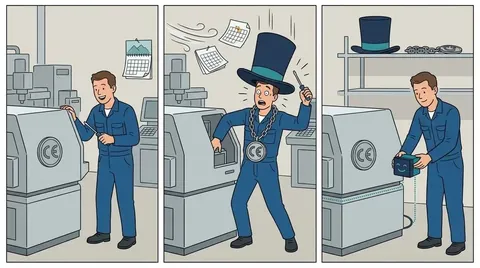
Two hard deadlines, no transition period, and one clause almost nobody has read
The landscape of cybersecurity legislation is no longer evolving, because in 2027 it lands, as two EU regulations start applying within eleven months of each other, both without a transition window, and between them they change what a CE mark on an industrial machine actually certifies. That pair of texts is what we call the 2027 cybersecurity legislation in this article.
If you operate machinery in Europe, or sell it there, 2027 is not a year to watch, but a year to have prepared for.
The 2027 cybersecurity legislation is a matter of deadlines, not trends
Most legislative round-ups hedge, but this one does not need to, because the two dates that matter in the 2027 cybersecurity legislation are already fixed in published regulations and neither has a grace period.
| Date | Instrument | What changes |
|---|---|---|
| 20 January 2027 | Machinery Regulation (EU) 2023/1230 | Replaces the Machinery Directive outright, and cybersecurity becomes an essential health and safety requirement for CE marking. |
| 11 December 2027 | Cyber Resilience Act (EU) 2024/2847 | Full application, and every product with digital elements placed on the Union market carries security obligations across its lifecycle. |
The absence of a transition window is the part that catches people, because a machine placed on the market on 19 January 2027 is governed by the old Directive while the same machine placed on the market a day later is governed by the Regulation, and there is no mixed regime and no opt-in period. For a reader coming to this cold, the CE mark is the manufacturer's declaration that a machine meets the EU's essential requirements, so changing what that mark certifies changes what a manufacturer has to prove before selling.
20 January 2027: cybersecurity becomes a safety requirement
The Machinery Regulation replaces Directive 2006/42/EC, the framework that has governed the CE marking of machinery since the 2000s, and most of the coverage focuses on machine learning and notified bodies, which are the independent laboratories designated by member states to assess conformity, while for anyone working on OT security the more consequential change is quieter.
Cybersecurity moves into the essential health and safety requirements, since Annex III introduces a section titled protection against corruption (§1.1.9), alongside reinforced requirements on the safety and reliability of control systems (§1.2.1). In substance, connection to other systems or remote access must not create a hazardous situation, and safety-related software, data and hardware components must be identified as such and protected against corruption, whether accidental or deliberate.
That is a genuine shift in legal character, because under the Directive protecting a machine against tampering was a matter for the manufacturer's judgement, whereas from January 2027 it is a condition of placing the machine on the market at all. Industry associations asked for the cybersecurity requirements to be deferred to the CRA date, but as far as we know that deferral has not been granted.
The clause almost nobody has read: substantial modification
Here is the provision that ought to be on the desk of every maintenance and engineering manager in Europe, and rarely is.
The Machinery Regulation defines substantial modification in EU law for the first time, and the consequence is short and severe, since whoever performs a substantial modification becomes the manufacturer for the aspects affected, with the attendant conformity assessment, technical documentation and liability.
Read that alongside how OT security retrofits have typically been done, because you open the cabinet, insert a module into the safety-related control circuit, rewire and close the cabinet. In 2026 that is a warranty conversation and a risk-assessment question, but from 2027 it is a question about whether your maintenance team has just become a machinery manufacturer, in a domain where the requirements now include cybersecurity of safety functions.
We have argued elsewhere that OT retrofits should be add-ons rather than upgrades and should sit at the boundary of a machine rather than inside it, on cost and liability grounds. The Machinery Regulation does not make that argument for us, but it does something more useful, which is to write the liability half of it into directly applicable EU law. Any 2027 retrofit plan should therefore have an explicit answer to the question does this constitute a substantial modification?, and the safest answer is the one where nothing inside the machine was touched.
11 December 2027: the CRA reaches full application
The Cyber Resilience Act entered into force on 10 December 2024, and its reporting obligations, for actively exploited vulnerabilities and severe incidents, apply from 11 September 2026. Full application arrives on 11 December 2027, and it is broad, since it covers the essential requirements in Annex I, technical documentation, vulnerability handling across a defined support period, and a conformity route that varies with product class.
Two points matter more than the headlines.
It is extraterritorial, because the CRA binds any manufacturer placing a product with digital elements on the Union market, wherever they are established, so a US, Japanese or Taiwanese vendor selling into the EU is in scope and must have an authorised representative or importer carrying the obligations. Readers outside Europe who have filed the CRA under "European problem" have filed it wrongly.
Machinery manufacturers are in both regimes at once, since the CRA's own recitals make clear that machinery makers must comply with both instruments, and the Commission and the European standardisation organisations are expected to promote consistency in how cybersecurity risk is assessed across the two, but that consistency is a work in progress rather than a settled fact, and we come back to it below.
And on access control specifically, Annex I is unusually direct for a product regulation, because products must be protected from unauthorised access by appropriate control mechanisms, including but not limited to authentication, identity or access management systems, and must report on possible unauthorised access. That is a product regulation using the phrase "identity or access management systems" in its operative text.
Standardisation: what to expect, and when
The Cyber Resilience Act does introduce a unified framework for cybersecurity requirements, and standardisation is genuinely the trend to watch, but it is worth being honest about where that standardisation currently stands rather than describing it as accomplished.
Harmonised standards are what turn an essential requirement into a testable specification and give manufacturers a presumption of conformity, and for machinery cybersecurity that layer is still being built, because EN 50742, addressing protection against corruption in machinery, is under development, and sector work such as the 2025 revision of ISO 10218-2 for industrial robots has begun folding cybersecurity requirements into safety standards. For the CRA, the standardisation request is substantial and the timetable is tight against December 2027.
The practical consequence for a manufacturer is uncomfortable but manageable, because you may reach an application date before the harmonised standard you would have relied on is cited in the Official Journal, and that does not suspend the requirement. It means demonstrating conformity by other means, namely a documented risk assessment, recognised international standards such as IEC 62443, and evidence you can put in front of an assessor.
The practical consequence for an operator is different and more interesting, because machines placed on the market from 2027 will arrive with tamper protection, software identity and logging that today's installed base simply does not have. Your estate becomes two-speed, with a growing minority of assets with usable security primitives and a large majority (the presses, drives, benches and cabinets commissioned between 1995 and 2026) that will never have them and cannot be retrofitted internally without the substantial-modification question above.
Governing that majority is not a 2027 problem, it is the problem the 2027 cybersecurity legislation makes visible.
Also landing, and worth tracking
- AI Act, 2 August 2028. Regulation (EU) 2026/1744 of 8 July 2026, known as the Digital Omnibus on AI, postponed to 2 August 2028 the obligations for high-risk AI systems linked to Annex I products, and to 2 December 2027 those for Annex III systems. It also moved the Machinery Regulation to Section B of Annex I of the AI Act. For a machine, AI-specific requirements therefore go through delegated acts supplementing the Machinery Regulation, applicable from 2 August 2028. If you embed a machine-learning safety component, have it reviewed by a specialist.
- NIS2 and CER enforcement. The transposition phase is ending and the supervision phase is beginning, because the Commission has moved from infringement proceedings to referrals before the Court of Justice, and national authorities that spent 2025 and 2026 registering entities will spend 2027 inspecting them. We have written separately about how to navigate NIS2 compliance.
- United Kingdom. The Cyber Security and Resilience Bill remains a Bill, in the House of Lords at the time of writing, and it will amend the NIS Regulations 2018 and bring managed service providers and designated critical suppliers into scope.
- United States. The picture is less flattering than the European one, and worth stating plainly, because the final rule under CIRCIA has slipped well past its statutory deadline, and the TSA's 2024 proposed rule for surface transport is not finalised. Outside NERC CIP in the electricity sector, binding American obligations remain thinner than the headlines suggest.
What to do with the time left
- Map your product range or your estate against the 20 January 2027 cut. For manufacturers, which products change Annex I category, and which lose the self-certification route, and for operators, which machines you expect to purchase after that date, and what security primitives they will arrive with.
- Put the substantial-modification question into your retrofit approval process, before the engineering and not after, because it is a one-line addition that can prevent an expensive category error.
- Review how software identity and tampering evidence will be captured and stored, since both regimes ask for it, and neither accepts "the machine's hour counter" as an answer.
- Compile the OT asset inventory if you have not already, because every obligation above is scoped by a list most organisations have never produced.
- Do not wait for harmonised standards to start. Design against IEC 62443 and document the reasoning, and the standard, when it lands, will be a mapping exercise rather than a redesign.
What we are not claiming
Two limits, stated because compliance writing tends to blur them.
We are describing published dates, not predicting enforcement, because how aggressively national market surveillance authorities act in the first year of the Machinery Regulation is genuinely unknown, and anyone telling you otherwise is guessing, so the dates are certain while the intensity is not.
None of this is legal advice, and the two regulations interact in ways the Commission itself has undertaken to clarify through guidance, so if your product sits near a category boundary (a safety component, a machine embedding machine learning, a product that is arguably both machinery and a product with digital elements) that boundary is worth a specialist's opinion rather than a blog article's.
What we can say with confidence is narrower and, we think, more useful, because from 2027 the cybersecurity of a machine's safety functions is a CE-marking matter, opening a machine to secure it carries a legal consequence it did not carry before, and the installed base that will never comply on its own terms is the part of the estate that needs governing from outside. That, in a few lines, is what the 2027 cybersecurity legislation asks of you.
Last reviewed: August 2026. Regulatory timetables and standardisation status change, so verify against EUR-Lex and your notified body before relying on any date here.